
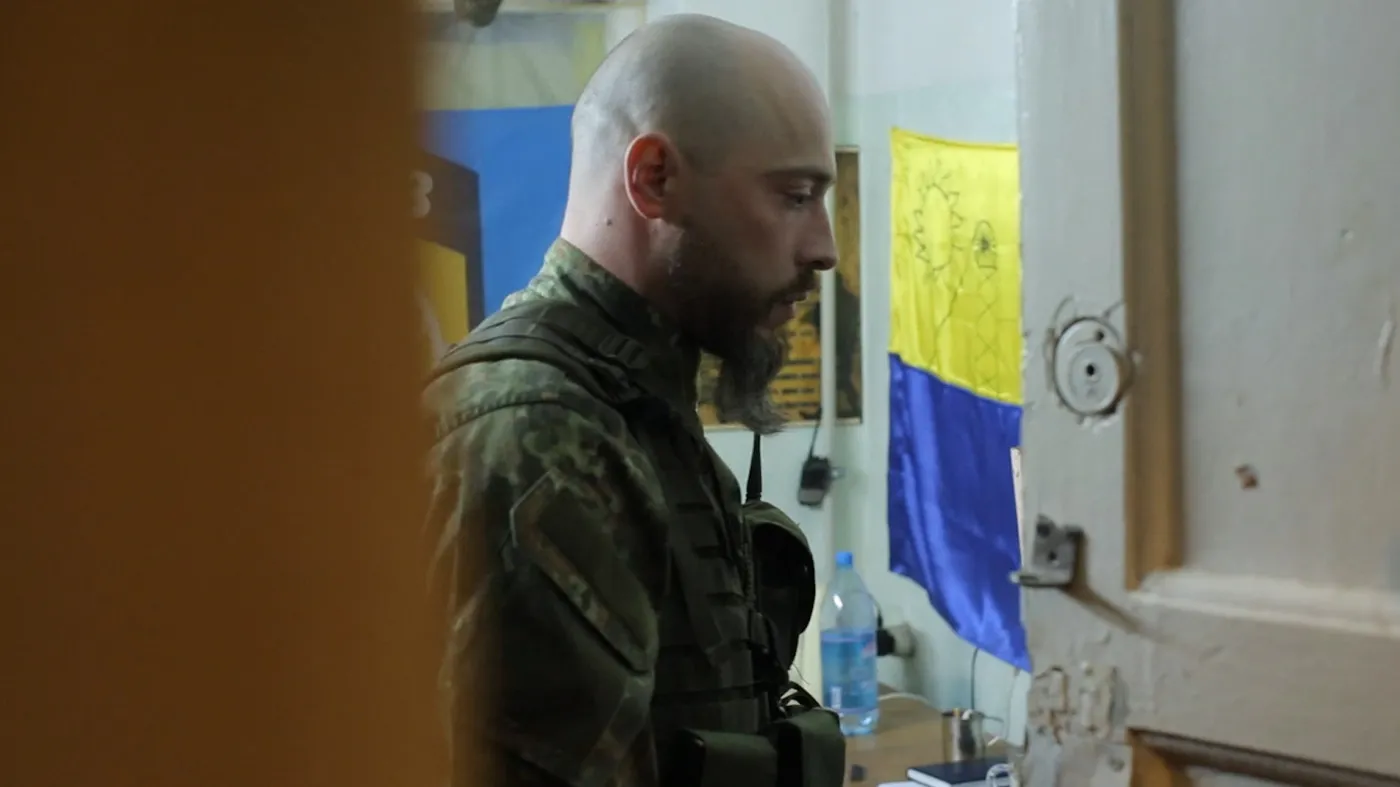
You may have seen quite a few documentaries about Ukraine and the impact of Russia’s war against the country in recent years. But Yuliia Hontaruk‘s To Die to Live, which just world premiered in the Special Screenings program of the 60th edition of the Karlovy Vary International Film Festival (KVIFF), takes a longer-term view and journey.
The film from the director of Ten Seconds follows three Ukrainian volunteers across 12 years of war: “from the frontlines of 2014, through the painful return to a life that no longer quite fits, and back into the fire once more in 2022.”
The KVIFF website describes it as “a quietly devastating film about the impossible task of making peace with death and the unrelenting desire to live.”
To Die to Live explores the stories and traumas of Shakhta, Dancer and Potter who volunteered for the army to fight in the Russo-Ukrainian conflict in Eastern Ukraine in 2014. Although the horrible things they experienced during two years on the front accompany them for every second of their existence, they try to return to civilian life. But the Russian invasion in 2022 forces them to again confront the war.
Written and directed by Hontaruk, the doc from Babylon 13 Production features cinematography by Denys Strashnyi, Yurii Gruzinov and Hontaruk. The editors are Roman Liubyi,Uģis Olte, Mykola Bazarkin, Hontaruk, Iryna Stetsenko, Pavlo Zelenov and Petro Tsymbal. The producers are Hontaruk, Ivanna Khitsinska, Alexandra Bratyshchenko, Uldis Cekulis, Katarina Krnacova and Ihor Savychenko.
“Twelve years ago, I followed three young Ukrainian volunteers to the frontline. I thought I was making a film about war. I was wrong,” Hontaruk shares in a director’s statement. “When the Minsk agreements came and they returned home, I followed them back. And that is when the real film began. What I witnessed in the years that followed was a profound and painful journey.”
She concludes: “What began as a portrait of conflict became something I never expected: a film about transformation, about the long and difficult road back to oneself, about how stubbornly life insists on continuing even in the shadow of death. This is not really a film about war. It is about what war leaves inside people, and what they do with it.”
While it is a “delicate” doc, “at its heart, it is life-affirming,” Hontaruk says. “Because despite everything, despite all the loss and rupture and years of waiting, life has proven itself stronger than death. Again and again, I men choose it. That is the film I set out to make, even when I didn’t know it yet.”
