
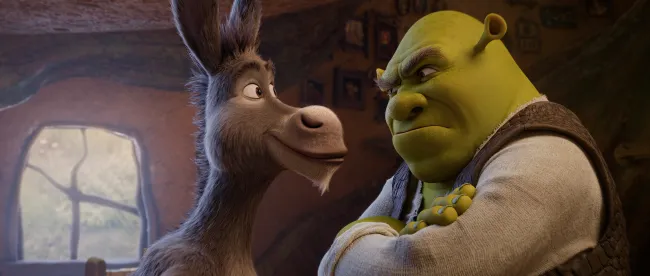
After a nearly two-decade break, Shrek is finally emerging from the Far Far Away swamps. The beloved green ogre and his eternal companions Fiona and Donkey are coming back to the big screen next summer courtesy of DreamWorks Animation’s Shrek 5. But fans have already noticed that there’s something different about this Shrek — like maybe he’s been in using a few too many mud masks.
As teased in early trailers and images, Shrek 5 introduces a bold new art direction for the franchise that’s a departure from the hyper-realistic style fans have known and loved since the 2001 original. The fifth installment notably leans into a more cartoonish aesthetic with characters sporting richer colors and less anatomically precise features — all in service of a more exaggerative, expressive look.

This visual shift is accompanied by a timeskip: Shrek is now seemingly middle-aged (ogre wrinkles included), while Fiona appears to have had some work done, according to a vocal segment of Shrek fandom. Meanwhile, their triplets, Felicia, Fergus, Farkle, have matured into teenagers voiced by Zendaya, Marcello Hernández, and Skyler Gisondo. Naturally, Mike Myers, Eddie Murphy, and Cameron Diaz are back in their signature roles.

Those updates have many fans wanting to “do the roar” in frustration. Much of the criticism stems from a sense that Shrek’s original visual identity was rooted in a distinctive, countercultural irreverence, and has now been sanded down into something more polished and generic. After the official teaser trailer dropped on June 16, the backlash persisted on social media, which lit up with negative reactions ranging from The Godfather-inspired GIFs on Twitter to sharply worded Instagram comments.
But some industry professionals are genuinely puzzled by the uproar. “I thought, ‘That’s Shrek, no doubt about it,’” Simeon Kondev, independent animator and creator of the YouTube series Society Animals, tells Gold Derby. “I started to pay more attention when the discourse about their updated designs kept appearing on my feed.
“I was surprised that people noticed the subtle differences,” Kondev adds. “It was even more surprising to see everyone making such a stink about it. But I don’t believe that people feel as strongly about it as they say. I suspect it’s just disingenuous engagement with content on the internet.”
A swampy start
The Shrek franchise has long been a cultural touchstone for millennial and Gen Z audiences. At a time when Disney was going through a fallow period with its non-Pixar animated offerings, Shrek stood out as a formidable competitor thanks to its irreverent storytelling, sharp jabs at the Mouse House, and barrage of pop culture references, all delivered through a visual identity that embraced CG animation when the medium was still relatively new. The original Shrek also holds the distinction of being the first-ever winner of the Best Animated Feature category at the Oscars, which was introduced at the 2002 ceremony.
Looking back, though, that early CGI hasn’t aged gracefully. “Shrek‘s 2001 look contrasts with its contemporaries, Monsters, Inc. and Jimmy Neutron: Boy Genius, whose stylized character designs more closely resemble children’s media of the time,” Kondev observes. “Shrek‘s original design is a surprising choice for a franchise based on fairy tales and aimed at families and young children.”
“I’ll be honest — the original Shrek films are ugly,” agrees Hamish Steele, animator and creator-showrunner of Netflix’s Dead End: Paranormal Park. “Like Final Fantasy: The Spirits Within and Dancing Baby GIF rancid. But that is a huge part of their charm and what made them feel grittier than what Disney was doing at the time.”

Former Pixar VFX artist Jesse Weglein also weighs in, drawing a comparison between the 16-year gap that separates Shrek 4 and Shrek 5 and the 11-year hiatus between Toy Story 2 and Toy Story 3. “The price of successfully creating and maintaining a massive franchise like Shrek is that you can often become locked into your own previous limitations,” he explains. “We saw this at Pixar between Toy Story 2 and 3 when technology had advanced so significantly with rendering and lighting that the studio had the opportunity to push photorealism but chose to be very conservative visually to maintain continuity as much as possible.
“This isn’t to say that Pixar didn’t utilize all of their tools to make the film amazing,” Weglein notes. “But a lot of it was under-the-hood or subtle enough to not cause a visceral hiccup from the improvement in quality in every step of the pipeline.”
Building a better pipeline
In the years since Shrek Forever After‘s release in 2010, DreamWorks’s production model and tools have undergone seismic shifts. PDI (Pacific Data Images) — the studio that animated the early installments — was shuttered in 2015, with some features later outsourced to other animation houses and others produced at DreamWorks’ Glendale, Calif., campus. Starting in 2019, the studio began rendering all of its features using its proprietary in-house software, Moonray.
That list included the beloved spin-off Puss in Boots: The Last Wish, which managed to retain much of the Shrek universe’s visual appeal while stylizing the swashbuckling feline against a watercolor storybook backdrop. Puss in Boots directors Joel Crawford and Januel Mercado are exploring that style even further on their upcoming DreamWorks film, Forgotten Island.

Kondev notes that Shrek 5‘s rendering update extends beyond character design. He observes that the teaser’s cinematography follows the trend of contemporary live-action films, employing low-key lighting, colored gels, soft shadows, and a shallow depth of field that leaves backgrounds dark and blurry. All of these stylistic choices stand in stark contrast to the brighter, more evenly lit visuals of the earlier Shrek movies.
“Shrek always went for this strangely hyper-real style, so tweaking anything about their proportions feels massive,” Steele observes. “But honestly, no executive would approve releasing a kid’s movie in 2027 where the humans look like barely rendered Sims. I don’t even know if studios would know how to do that anymore.”
Ugly Shrek?

The Shrek 5 backlash is reminiscent of the “Ugly Sonic” discourse in 2019, when the overwhelming fan outcry over the initial cinematic design of the Sega mascot prompted Paramount Pictures to completely overhaul the film, delaying its release by four months. To date that remains the most notable modern case of fan backlash actually affecting a movie — and for the better, as Sonic the Hedgehog is now a major franchise with a fourth installment dashing into theaters a few months before Shrek 5.
But much of the Sonic redesign involved a single CG character against a completely live-action backdrop. Shrek 5, by contrast, is an entirely CG-animated film featuring numerous characters. It would be a labor intensive and financially daunting undertaking to have animators go back and update the film according to fan demands.

Weglein explains that conversations regarding an animated film’s visual style occur very early on in production, and sheds light on a harsh reality that plagues productions facing delays,
“There are examples at many studios where a film has to undergo a change based on feedback after the train has left the station,” he says. “These changes are much more expensive to integrate successfully and threaten pushing back the release, negatively impacting all subsequent dependencies that rely on that target date from theatrical jockeying with your competitors to needing to pay to warehouse millions of toys for fast-food promotions and everything in between. It also forces time compression on your crew, impacting the film’s ability to reach its full potential within the remaining time and budget.”
The times they are a-changin’

According to the animation experts consulted for this piece, opinions vary on whether the audience outcry might constitute an overreaction. “Shrek 5 isn’t for you, it’s for kids,” says Steele. “Maybe it would’ve been more interesting had they decided to make an adult Shrek movie? But they didn’t. And that’s OK.”
“I kind of get why audiences might be upset,” Kondev acknowledges. “The originalShrek look was pioneering and risky, and that made it memorable and interesting. What was uniquely ugly is now becoming more homogenous, like a grimy version of Trolls World Tour.” (It’s is worth noting that Trolls World Tour director Walt Dohrn — who also voiced Rumpelstiltskin in Shrek Forever After — is a director on Shrek 5 alongside Brad Ableson and Conrad Vernon.
Weglein offers a more measured perspective. “I think audiences are overreacting a bit to something that looks different, but I think it’s because they are protective of something they love,” he says. “If they didn’t care about Shrek, there would be very little outcry. Change is hard, but I have faith that when audiences see the film, the new look will hold up well against its own legacy for another 25 years.
“Look at Toy Story vs. Toy Story 5,” he adds. “The quality of the story is the eternal golden thread, not the massive amount of technical and art improvements that occur over time.”

As for Shrek 5’s Oscar chances, the design debate likely won’t have much influence over the outcome of the 2028 Best Animated Feature race. “I think the biggest hurdle Shrek 5 has to overcome to win the Oscar is that it’s Shrek 5,” Steele expresses. “The last few winners of Best Animated Feature have been more interesting than that.
“Obviously, we all knew KPop Demon Hunters was going to win, but nobody would’ve guessed that a year in advance. And winners like Flow, The Boy and the Heron, and Guillermo del Toro’s Pinocchio makes me think there’s a higher chance of some random European animation that nobody has heard of yet [winning the prize].
“Or if Spider-Man: Beyond the Spider-Verse does come out next year, it’ll be that,” Steele adds. “Sorry, Donkey!”
