
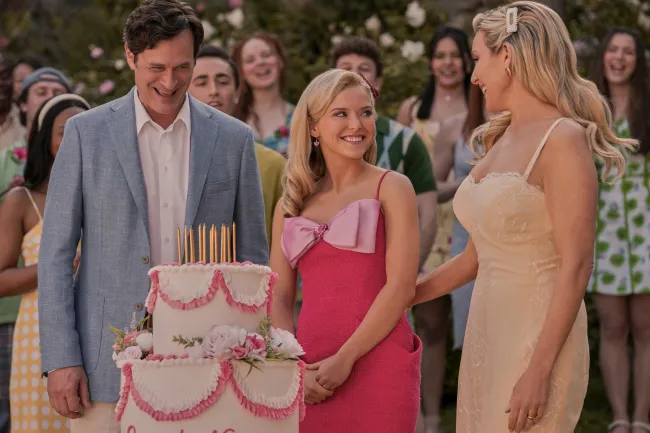
Not everything is coming up roses, or pink, for Elle, Amazon’s highly anticipated Legally Blonde prequel series. While critics agree newcomer Lexi Minetree looks the part of a young Elle Woods (originated by Reese Witherspoon), the consensus is that the show is an uninspired piece of nostalgia bait. By ditching the film’s smart comedy for sluggish teen drama tropes, this origin story ultimately struggles to bridge the gap between a naive high schooler and the iconic Harvard law grad we know and love. In short: The defense rests, but the critics strongly object!
As of Tuesday afternoon, Elle has a 55% score on Rotten Tomatoes and a 47 rating on Metacritic. Below is a sampling of the critical reaction.

Angie Han at The Hollywood Reporters finds the series to be a “cute-enough” teen show on its own merits, but she ultimately argues that the project “makes no sense as a Legally Blonde prequel.” She notes that stripping away the foundational character growth of the original movie creates a disconnect. “The entire premise of the earlier film was that this California girl arrives at Harvard oblivious to life beyond boys, clothes and sorority sisterhood; Elle’s reveal that she’d previously spent her teen years amid the grunge rockers and activists of Seattle is a character inconsistency so gaping it’d require a Days of Our Lives-level bout of amnesia to fill it.”
In his review for TVLine critic Dave Nemetz gives the series a C grade, noting that while it has some clever moments and solid performances,” it ultimately trades the original film’s brilliance for predictable tropes. Nemetz praises newcomer Lexi Minetree, but argues that the show frequently stalls by leaning “too often into YA drama tropes like the inevitable love triangle.” He laments that the series sacrifices its cinematic legacy for uninspired network-style conventions, concluding that the adaptation functions as “an uninspired piece of IP nostalgia bait that is mostly harmless — but pretty forgettable, too.”
The Wrap‘s Marah Eakin delivers a highly critical assessment, panning it as a sluggish and disappointing departure from the vibrant spirit of the original film. Eakin argues that while transplanting a young, pink-clad Elle Woods into grunge-era Seattle is an interesting premise on paper, “in practice it feels thin and forced.” She finds that the sluggish pacing and overwhelming product placement drain the story of its potential charm, ultimately concluding that while the 2001 movie was a brilliantly paced cultural touchstone, “Elle is dour, boring and tedious.”

In his review for IndieWire, critic Ben Travers delivers a scathing D-plus assessment and argues that the project fundamentally misunderstands its source material, asserting that the prequel premise simply doesn’t make sense: “It’s impossible to believe this version of Elle Woods could become that version of Elle Woods.” He notes that the show completely abandons its comedic roots in favor of tepid teen drama and a lazy mystery, writing, “At best, Elle is amusing, but only every 10 minutes or so. The rest of the time it’s focused on common teen drama plots — forming friendships, breaking friendships, reforming friendships, developing crushses, breaking crushes, redeveloping crushes, etc. — and, for reasons that never become clear, a season-long mystery.”
