
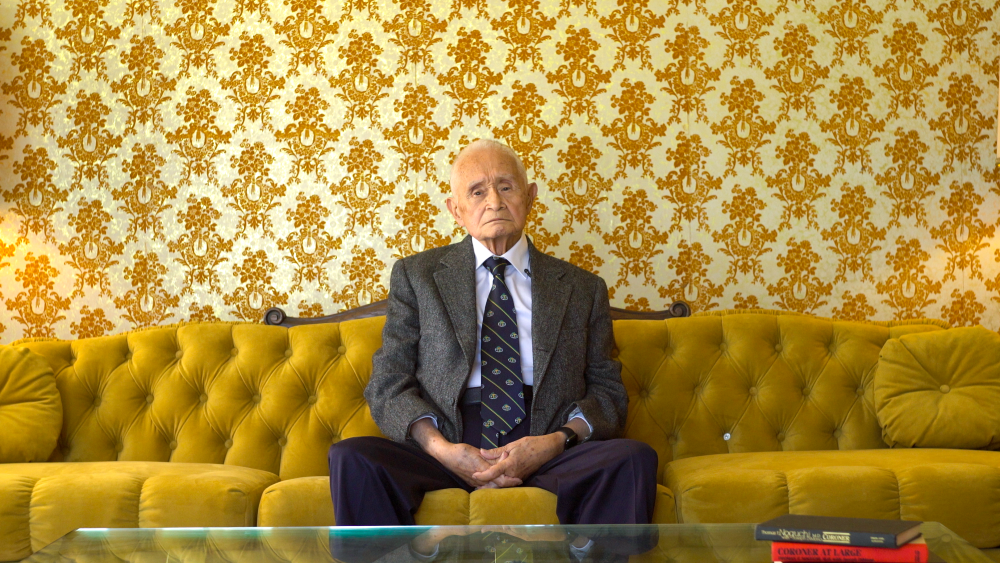
You may not have heard of him, but he’s had a hand in some of the biggest cultural events in American history. The death of Marilyn Monroe. The Watts riots. Senator Robert F. Kennedy’s assassination. The Manson Family murders. Natalie Wood’s drowning. And he was so reviled by the Hollywood establishment that none other than Frank Sinatra hand-delivered a letter calling for his ouster. The story of Dr. Thomas Noguchi, chief medical examiner and coroner for Los Angeles County during the social upheaval of the ‘60s and ‘70s, is immortalized in the new documentary “Coroner to the Stars.” And it’s a tale that must be seen to be believed.
Directed by Ben Hethcoat and Keita Ideno, and embarking on a nationwide roadshow on June 23 before a July 14 digital release, “Coroner to the Stars” traces Dr. Noguchi’s journey from Yokosuka, Japan, to the bright lights of Los Angeles, where he performed autopsies on luminaries like Marilyn Monroe, Robert F. Kennedy, Sharon Tate, Janis Joplin, William Holden, Natalie Wood and John Belushi. His renown inspired the NBC medical drama “Quincy, M.E.,” and his candidness with the press — “tell it like it is” being a personal credo — riled the celebrity set, leading to smear campaigns against him and the Japanese American community (including George Takei) rallying to his defense, alleging racial discrimination.
These days, the 99-year-old doctor is still plenty active, having recently returned from a trip to his native Japan, where he took in a sumo wrestling match. And he never officially retired, still traveling to medical conferences across the globe in order to retain his medical license.
“I’m the same animal, always observing,” Dr. Noguchi tells Variety.
Dr. Thomas Noguchi back in the day
Antenna
He was born into a doctor’s family — his father, Dr. Wataru Noguchi, practiced in Yokosuka — and, following World War II, emigrated to the U.S. in 1952. Shortly thereafter, he was diagnosed as having possible early tuberculosis and admitted to Barlow Sanatorium for a year and a half. While under observation, he met Hisako, a research assistant studying the organisms that cause tuberculosis. The two would eventually marry.
Despite graduating from Tokyo’s esteemed Nippon Medical School, Noguchi’s 200 internship applications only resulted in two acceptances: Johns Hopkins and Orange County General Hospital. He trained at the latter and started working in Los Angeles County’s medical examiner’s office in 1961. The following year, as a deputy medical examiner, he was thrust into the spotlight after being tasked with performing the autopsy on screen icon Marilyn Monroe.
“It was a challenging assignment,” recalls Dr. Noguchi. “We conducted not only a coroner’s investigation but requested to have a panel of experts on suicide prevention and suicide determination, and that way [there was] a more scientific determination.”
The autopsy found high levels of barbiturates in the lining of Monroe’s stomach, and that, coupled with the Los Angeles Suicide Prevention Team’s reports of chronic depression and drastic mood swings, led Dr. Noguchi to label Monroe’s death a “probable suicide.”
Of course, that hasn’t stopped conspiracy theorists from believing foul play was involved. In Norman Mailer’s 1973 tome “Marilyn: A Biography,” the self-admitted fabulist contended that Monroe was murdered by FBI and CIA agents in order to cover up her supposed affair with Senator Robert F. Kennedy. That theory was echoed in Netflix’s 2022 documentary “The Mystery of Marilyn Monroe: The Unheard Tapes,” wherein journalist Anthony Summers alleges that RFK got into an explosive breakup argument with Monroe hours before her death and was one of the last people to see her alive.
But Dr. Noguchi still stands by his “probable suicide” determination.
“Oh yes,” he says. “Especially well-known cases attract rumors and exaggerated stories regarding the investigation, and people tend to believe what they hear. It’s my job to conduct an investigation and an autopsy, and to come to a scientific determination of the cause of death rather than speculation.”
The Monroe case granted Dr. Noguchi visibility, and he soon applied to succeed his mentor, Dr. Theodore Curphey, as the chief medical examiner of Los Angeles County. Though he was the only non-white applicant, and told during the process “you’re a good second man,” Dr. Noguchi won the job, taking office in 1967.
One year into the role, he faced another headline-grabbing case: Senator Robert F. Kennedy’s assassination at the Ambassador Hotel in Los Angeles. Dr. Noguchi conducted the autopsy, releasing an extensively detailed 63-page report that concluded RFK was shot three times, with the fatal shot entering behind Kennedy’s right ear at a distance of approximately 3 inches away. To gauge the distance, Dr. Noguchi oversaw ballistics tests where shots were fired from various distances at a pig’s head in order to compare the gun powder residue patterns with those found on RFK’s body.
Since the man convicted of the murder, Sirhan Sirhan, approached Kennedy from the front, Dr. Noguchi’s finding that the fatal shot entered from the back of Kennedy’s head has led to numerous conspiracy theories involving a second gunman.
“That did not happen though,” maintains Dr. Noguchi.
While Dr. Noguchi stands by his determination that the fatal shot entered from behind Kennedy’s right ear, he believes that the position of the senator’s head could have changed.
“If the senator was looking at the assailant it does not make sense that it came from the back. However, the position of the head changes rapidly, especially, as I understand, as the senator was shaking hands with kitchen staff. His head could have moved and changed position, which is important in understanding how it happened,” Dr. Noguchi reasons, adding, “Sirhan Sirhan was in front of the senator, however, if he moved to the position of looking toward his right, the situation changes completely.”
Public outcry over the Robert F. Kennedy autopsy found Dr. Noguchi in the crosshairs of the Los Angeles County Board of Supervisors, a powerful cabal known as “The Five Kings.” After a fantastical allegation that Dr. Noguchi danced in celebration of the RFK assassination, marveling at the fame it would give him, he resigned — only to rescind the resignation and, with the support of Japanese American civil rights activists, accuse the board of targeting him over his race.
“My husband is good enough to work under a Caucasian but not good enough to work in the position of chief,” his wife, Hisako, said at the time. “There is nothing equal about this equal opportunity business if a minority group member has to have ten times more education to successfully compete against a member of the Caucasian race.”
Dr. Noguchi won his appeal and was reinstated as chief medical examiner. But he found himself under renewed scrutiny when the actress Natalie Wood’s lifeless body was found in the waters off Santa Catalina Island. Wood was aboard the yacht Splendour along with her husband, Robert Wagner, “Brainstorm” co-star Christopher Walken and the ship’s captain Dennis Davern. According to Dr. Noguchi, Wood died of accidental drowning and hypothermia. Since she had scratches and bruises on her body, as well as a blood-alcohol content of 0.14%, Dr. Noguchi said that Wood may have slipped while intoxicated and trying to board the dinghy. He also stated during a press conference that an investigation revealed Wagner and Wood had gotten into an argument just prior to her death. (Wagner later admitted as much in his memoir, but has denied any involvement in Wood’s death.)

Dr. Thomas Noguchi and director Ben Hethcoat
Antenna
In 2011, the case into Natalie Wood’s death was reopened after Davern came forward to say that he’d lied to police during their investigation; Wagner and Wood had a blow-up argument over Wood’s flirting with Walken; that Wagner refused to let him turn on the search lights to try and find her or notify the authorities; and that Wagner was ultimately the one responsible for her death.
“If he is a witness, then his opinion stands,” Dr. Noguchi says of Davern’s claims. “But I was not there, so I cannot say.”
The LA County chief medical examiner amended Wood’s death certificate in 2012, changing her cause of death from “accidental drowning” to “drowning and other undetermined factors,” and that “it was not clearly established” how she ended up in the water. The following year, the coroner’s office added a 10-page addendum to her autopsy stating that the scratches and bruises found on her body may have occurred before she hit the water. Still, Dr. Noguchi stands by his findings.
“Many famous cases from my career continue to generate public interest and debate. I understand why people remain curious, and I respect that others may hold different opinions. However, my conclusions were based on the medical and forensic evidence available to me at the time, and those conclusions are reflected in the official autopsy reports. After all these years, I continue to stand by those findings,” he offers. “Whether the case involved a famous person or an unknown citizen, the duty was always the same.”
Dr. Noguchi’s decision to publicly share Wood’s blood-alcohol content following her death (as well as that of the late actor William Holden) so enraged their pal Frank Sinatra that he hand-delivered a letter to his supervisors that read: “I am particularly disturbed by Dr. Noguchi’s constant seeking of headlines and publicity for himself in investigations involving entertainers and other well-known individuals.”
Sinatra’s crusade, as well as a story in the Los Angeles Times alleging gross mismanagement in the medical examiner’s office, resulted in Dr. Noguchi’s firing in 1982.
“It’s a situation that has nothing to do with me,” he says of Sinatra. “I did not ask for any of this. I had a job as a medical examiner, and that’s it.”
Dr. Noguchi was exiled to the Los Angeles County + USC Medical Center, where he conducted research out of a basement office bearing the sign “Welcome to Siberia” and mentored the next generation of coroners. He also hosted a cooking show on public-access television and wrote a pair of books about his time as a coroner. One of those books was found by Hethcoat’s producer on the dollar rack, and “Coroner to the Stars” was born.
“What I was drawn to were these celebrity cases and how Dr. Noguchi was this ‘controversial’ figure in these cases and accused of different things like wanting the attention for himself,” says Hethcoat. “After working on the film, doing the research and talking to different people, my understanding of the complexity of the position really changed.”
“Coroner to the Stars” is, more than anything, intended to “preserve the legacy of a pioneer like Dr. Noguchi,” adds Ideno, its co-director. At a time when Japanese Americans were being persecuted, he rose to the top of his profession and helped shape the course of history. He was also a loving partner to Hisako until her passing in 2014. In the film, Dr. Noguchi speaks fondly of her and places a funeral wreath at her grave.
“In life, some people will have their opinions, and it’s OK,” Dr. Noguchi says, before cracking a smile. “I hope to continue until the age of 100 years.”
