
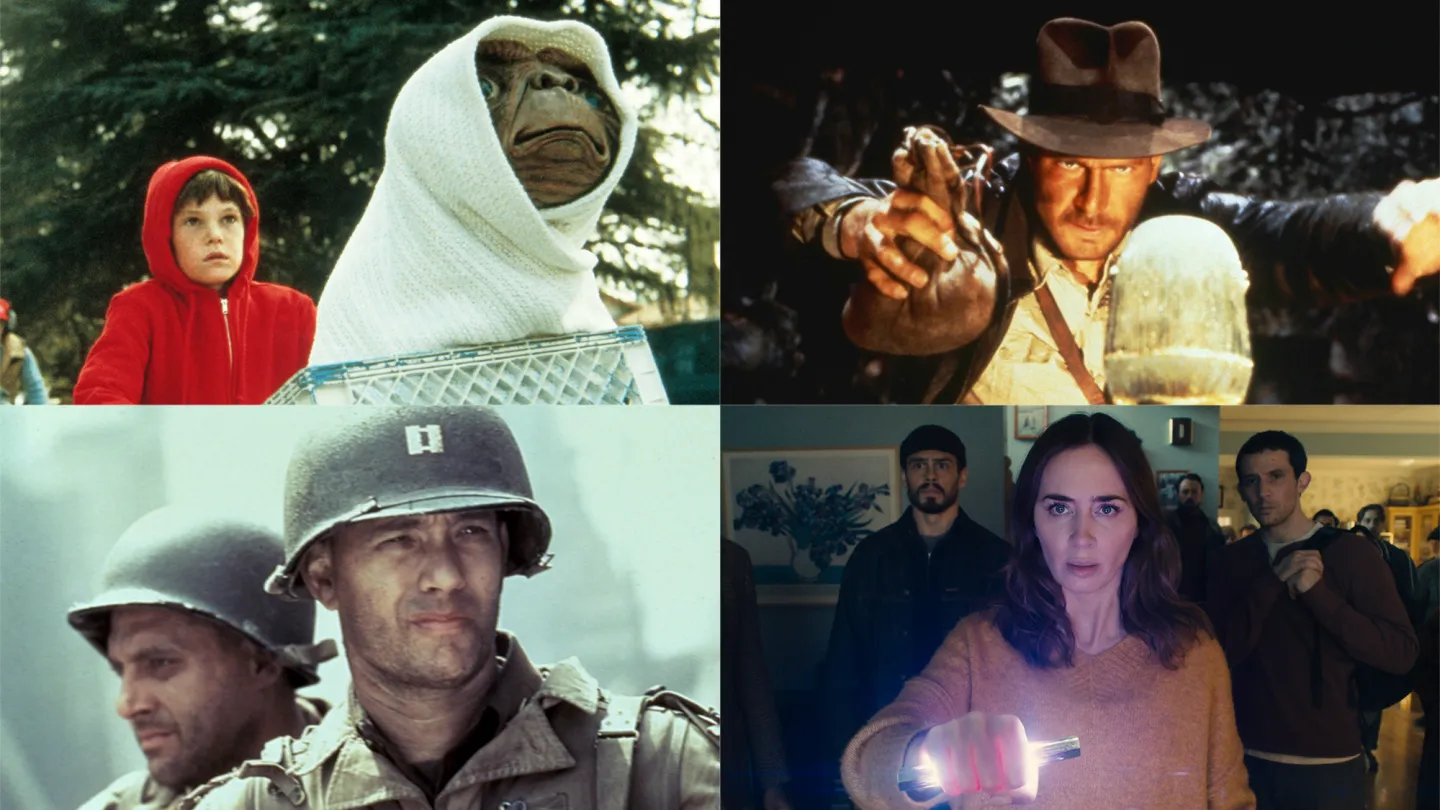
In Disclosure Day, the whole human race watches the same thing at the same time. It’s in the trailer, all those staring eyes full of wonder. No logical person today thinks a worldwide audience can still share a collective feeling from one mass viewing experience. But creating global emotional events is, or was, Steven Spielberg’s job. The great white shark. The extra-terrestrial. He made archaeology fun. He had a T. Rex. His hard-R war pictures earned boffo dollars. His name still epitomizes success, no matter if he hasn’t directed a hit this decade. Is Disclosure Day his summer comeback, another low-turnout late masterpiece, more wannabe spectacle, One of the Weird Ones? Even his failures belong in a museum. His best work feels personal, connecting audiences to each other and to their own childlike sense of awe. His gigantic filmography — he directed two films in one year, six different years! — is a cozy house he built for everyone. We’re gonna need a bigger home.
-
35. The Lost World: Jurassic Park (1997)
Image Credit: Universal/Courtesy Everett Collection Because this dinosaur sequel is such a pointless romp where boring people get mauled so a billionaire can rally public opinion for a boardroom showdown, it’s worth noting how remote Spielberg’s output could feel at his ‘90s peak. Far from the suburbia of his early Amblin days, his films now took place on distant islands and in long-ago times. David Koepp’s script tries to fix Michael Crichton’s lame book a few dumb ways, adding poachers and a stowaway daughter who slays a raptor using gymnastics. For no apparent reason, San Diego gets kaiju’d. The first time you see Jeff Goldblum, he’s yawning. The climax puts the T. Rex to sleep.
-
34. The BFG (2016)

Image Credit: Courtesy of Storyteller Distributuion Co.
In Roald Dahl’s 1982 novel, Queen Elizabeth II does not fart hard enough to lift a tablecloth. She doesn’t fart at all. But Steven Spielberg knew the Queen. She knighted him. In her honor, I assume, he bestowed upon her regal person not just any fart gag but the Buckingham Palace of screen flatulence. Penelope Wilton plays the British royal onscreen, flanked by telltale corgis exploding emerald buttgas out their rears. Her butler breaks wind, too, and a couple Generals. Those whizzpoppers sum up The BFG: gaseous, unpleasant, more loud than funny. -
33.5. “Kick the Can,” Twilight Zone: The Movie (1983)

Image Credit: Courtesy Everett Collection
In the days before a majority of living moviegoers grew up on Steven Spielberg, there were adults who didn’t trust his Amblin shtick. They called him the sellout who killed New Hollywood, and a movie brat who wouldn’t grow up. Harsh, but not always untrue. His inessential segment of this cursed Rod Serling revival is a literal retreat from adulthood, letting retirement-home denizens experience one schmaltzy night of youth regained. A Twilight Zone that isn’t scary? Why? -
33. Ready Player One (2018)

Image Credit: Jaap Buitendijk/Warner Bros.
Easy to assume this IP-stuffed nostalgia play was a cheatcode for better box office after The BFG flopped. Tye Sheridan and Olivia Cooke are the rebel gamers in 2045 waging VR war against an evil corporation. The real stars are the references: King Kong, Doc Brown’s DeLorean, Batman. Worth noting, though, how far this adaptation extends its lore beyond the rigid ‘80s focus of Ernest Cline’s novel. I choose to believe Spielberg hand-picked every homage: The Golden Voyage of Sinbad’s Cyclops, the commercial where the owl bites the Tootsie Pop, “Slappers Only,” Battletoads. The heroes dig Robert Zemeckis, Stanley Kubrick, and Brad Bird — friends and collaborators of Steven Himself — and they know what “padawan” means. It’s a dream of legacy: Tomorrow’s children will be fanboys using their vast knowledge of Spielberg-approved pop culture to defeat well-funded haters. Does he realize, though, how many fanboys are haters now? -
32. Indiana Jones and the Kingdom of the Crystal Skull (2008)

Image Credit: Everett
Colonel Jones spied on the commies for Uncle Sam. You can’t trust anyone these days, though. Feds ransack his office, lean on his bosses, ruin his reputation: McCarthy shit. He’s hounded by the FBI and the KGB. Protestors on his campus scream “Better Dead Than Red!” Greasers and preps rumble at the diner. His country is nuking itself. Spielberg’s final collab with life-long sand-castle buddy George Lucas spends more time stateside than the other Indy adventures, and the early scenes tap a vein of dumbo-political surrealism, like some mad movie scientist wanted to mix the filmmakers’ best solo work together but accidentally blended 1941 with Attack of the Clones. Darn it, I like the refrigerator: It’s the pulp hero on the nuclear frontier, Indiana Jones and the Mushroom Cloud.Then he flies to Peru. Digital ants, digital monkeys, digital aliens. No, no, no.
-
31. 1941 (1979)

Image Credit: Universal/Courtesy Everett Collection
Ever been the only person at the party who didn’t snort cocaine? That may have been straitlaced Spielberg’s actual experience filming this dire farce. Days after Pearl Harbor, the streets of Los Angeles rage with tanks, anti-aircraft fire, a jitterbug contest and a Zoot Suit riot. Did you like when Slim Pickens bull-rode a hydrogen bomb in Dr. Strangelove? He’s here, and he’s constipated. -
30. The Terminal (2004) and 29. Always (1989)

Image Credit: DreamWorks/Courtesy Everett Collection
Spielberg was just too nice a boy for 1941’s attempt at National Lampoon-y chaos. His other bad airplane comedies are prettier, and replace empty snark with boring romance. The Terminal is his most delusional retreat from reality, proclaiming post-9/11 that airports are bright places for finding friends and sparking romance. Always is a fire-pilot fantasy where a dead jerk haunts his cool girlfriend.
Always
John Shannon/Universal Pictures/Courtesy Everett Collection
-
28.5. Something Evil (1972) and Savage (1973)

Image Credit: Courtesy Everett Collection; NBC/Getty Images
Efficient telefilms from his workman period. Evil is the more obvious forbear, a spooky-farm proto-Poltergeist sensitive to simmering tensions between a freaked-out mom, a checked-out dad and a disgruntled teen. Failed pilot Savage is a newsman potboiler about a Supreme Court nominee’s dead mistress. He wound up making three more movies with Supreme Court subplots, and you will find it baffling how much I love them all. -
28. Disclosure Day (2026)

Image Credit: Universal Pictures and Amblin Entertainment
I do not think a vast conspiracy has hidden interplanetary visitations for eight decades. I also don’t go to church. So I may not be the fandom for a preachy Alien Autopsy retread with serious nun talk. Non-Redditors can enjoy Emily Blunt as a local-news forecaster who gets brain powers from a bird. Her scenes with Wyatt Russell’s guitar-chump boyfriend are loose and fun, especially when they find out it’s hard to break a smartphone. Disclosure can’t quite juggle DEFCON stakes with an unconvincing flashback and NBC product placement. But the 79-year-old Duel director still gives good car chase. One oncoming-train setpiece pays homage to, well, Duel. -
27. The Adventures of Tintin (2011)

Image Credit: Paramount Pictures/Courtesy Everett Collection
If you love Dick Tracy, Sin City, Speed Racer or the trailer for the new Street Fighter movie, I assume you kinda don’t mind this unreal-on-purpose cartoon caper. Guilty. -
26. Hook (1991) and 25. War of the Worlds (2005)

Image Credit: Courtesy Everett Collection
The world is split between people who hate Hook and people who love Rufio. War of the Worlds has a more stable middling reputation: admired for its Ground Zero-infused imagery, condemned for its huggy anticlimax. Robin Williams’ yuppie Peter Pan and Tom Cruise’s dockyard weekend dad belong together, though. One misses ballgames for board meetings. The other doesn’t know about his daughter’s peanut allergy. Spielberg and Fathers: Go. The child of divorce grew into a divorced father, overseeing a vast cinema of absent patriarchs while co-parenting seven children. I think his family stories are stronger, though, when they focus on the kids and moms left behind. Williams and Cruise get to prove their mojo fighting pirates and blowing up aliens. If parenting were that fun, none of us would have daddy issues.
War of the Worlds
Paramount/Courtesy Everett Collection
-
24. Indiana Jones and the Temple of Doom (1984)

Image Credit: Everett
Harrison Ford is meaner in this prequel, and hotter. Kate Capshaw’s songstress screams often. Ke Huy Quan’s Short Round gets enslaved. The Indians are deceitful, brainwashed, helpless, or eating chilled monkey brains. Pankot Palace’s Prime Minister is played by Roshan Seth — right after he played an actual Prime Minister in Gandhi. That biopic arguably stole E.T.’s best picture victory, in the decade when dusty industry elders kept ignoring Spielberg’s popular sensations for Chariots of Fire and Out of Africa. These are not titles that come up often in film discourse today because the people who loved them are dead. Is that rude to say? The brands Spielberg and Lucas were building, Amblin and Lucasfilm, could be very rude indeed. It was a different time for PG ratings, when a kid-targeted film still had swears, lust and heroes who came off like shitheads. So there are indefensible things about Doom, but the ritual horror of its second hour is mesmerizing, and eerier than anything in his career until the surprise-ragnarok in A.I. -
23. Duel (1971)

Image Credit: Courtesy Everett Collection
A lot of storyboarding, a couple weeks of filming and this ABC Movie of the Week scored an international theatrical release. Dennis Weaver is the Angeleno businessman hunted across the desert by a truck driver we never see. Spielberg renders the inexplicable conflict into a primal showdown: The city boy in his little Plymouth Valiant, the truck brandishing Big West license plates from New Mexico, Nevada, Montana, Arizona, Idaho and Wyoming. Not a lost classic, but a crucial stepping stone. -
22. The Post (2017)

Image Credit: Courtesy of Niko Tavernise/Paraount Pictures
The wrong Spielberg opinion I’ve heard most is how he turned into a History Grampa, dedicated to the sort of middlebrow-centrist period pieces that used to steal his Oscars in the ‘80s. But there’s a vibrant clarity to his recent docudramas, which deftly use past events to mirror present concerns. This journalism panorama portrays The Washington Post’s reporting on the Pentagon Papers, tracking the flow of information between newsrooms, boardrooms, D.C. garden parties and the Oval Office. Squint a little and you can spot a WikiLeaks meditation — and that’s before The Post morphed into an in-the-moment reaction to Trump Year Zero and #MeToo. Icons play icons: Meryl Streep as publisher Katharine Graham, Tom Hanks as editor Ben Bradlee. Their first scene together is a minor-key marvel, a breakfast two-shot tracking the complex duel of their working friendship. It doesn’t cut for over three minutes: confident filmmaking, the complete opposite of Ready Player One’s flailing pyrokinetics. -
21. Saving Private Ryan (1998)

Image Credit: DreamWorks/Courtesy Everett Collection
I count four Spielberg films that take place during World War II. This does not include Indy punching Nazis in the 1930s, or the U.S.S. Indianapolis speech from Jaws, or the ageless 1945 pilots in Close Encounters, or the Band of Brothers trilogy, or the Medal of Honor game franchise, or the 40-minute war film he made as a teenager and memorialized in The Fabelmans. But unless you count a Twilight Zone segment he didn’t touch or the emotionally distant veteran dad in the forgotten ‘60s TV drama The Psychiatrist, his directorial career did not acknowledge the Vietnam War until he was 70 making The Post. It’s a visible absence, a critical boomer macronarrative ignored by this critical macro-boomer.So it’s possible to admire his fidelity to the Greatest Generation’s heroism — and wonder how much his Last Good War nostalgia was an escape from harsher reckonings. With Saving Private Ryan, Spielberg and cinematographer Janusz Kaminski created a new kind of screen violence: up-close, handheld, mud-spattered, shutter speeds so juked and lenses so flared any throwaway shot sparkles with jagged discontinuity. There’s no plot reason for the rescue squad’s mission to begin after a 23-minute D-Day scene and two minutes of George C. Marshall quoting Abraham Lincoln, except Spielberg realized before anyone else that you could blend gutgash mayhem with lonely-trumpet flagwaving corn. The action still looks — no other way to say it — totally rad. But even Spielberg wanted to leave this battlefield behind. His later American histories devisceralize the Civil War, the Cold War and Vietnam into hallways-of-power conversations and paper trails. Meanwhile, a generation of Ryan-influenced Call of Duty games let you go all Ready Player One on the beaches of Normandy whenever you want.
-
20. The Sugarland Express (1974)

Image Credit: Courtesy Everett Collection
Goldie Hawn plays the ex-con young mom desperate to rescue her son from his Methodist foster family. William Atherton is her husband, who agrees to sneak out of prison when she threatens him with no more sex. They’re half-dumb, she’s half-crazy, and this mix of high-speed media satire and down-home tragedy is a hidden gem of ‘70s car cinema, goosed by Vilmos Zsigmond’s hazy wide-horizon cinematography and a harmonica-heavy score from first-time collaborator John Williams. -
19. Amistad (1997)

Image Credit: Everett
Spielberg’s worst ending is Anthony Hopkins’ John Quincy Adams delivering a 10-minute summation to the Supreme Court. Until then, Amistad’s an impressive sprawl, focused on the nightmare toll of slavery and the legislative cobweb that kept the nefarious institution alive. Djimon Hounsou’s Cinque leads his fellow captives in a gory uprising. Then the Africans come to America, and the lawyers arrive. Matthew McConaughey is Roger Sherman Baldwin, the shady litigator who tries defending the rebels using a wrongful-transfer technicality. “Did Christ hire a lawyer,” asks Stellan Skarsgård’s booming abolitionist, “to get him off on technicalities?” Baldwin’s response sums up the cheeky-realist spirit of Spielberg’s legal thrillers: “But Christ lost.” -
18. AI: Artificial Intelligence (2001)

Image Credit: Warner Brothers/Courtesy Everett Collection
Stanley Kubrick spent decades developing this dystopian fairy tale. Spielberg made it in honor of his late friend. So probably the meanest opinion on this list is I think A.I. is worse than any film Kubrick made after Killer’s Kiss. But there’s no denying the brilliance of Haley Joel Osment, so weirdo-cute as the mecha-child trying to Pinocchio himself real. You sense a populist stretching for artiness: When the robot boy surprises his “Mommy” on the toilet, she’s casually reading Freud on Women. Themes! But the controversial ending is the most mysterious sequence of Spielberg’s career. -
17. Catch Me If You Can (2002)

Image Credit: DreamWorks/Courtesy Everett Collection
With pride he called himself a teenage con man. See young Steven strolling through the gates at Universal, without a pass, armed only with a suit and a briefcase and attitude. Or maybe he jumped off the Universal Studios tram and started visiting sets. Never let the truth get in the way of a good story, and don’t underrate this counterfeit caper as a self-portrait of chutzpah and truthiness. Leonardo DiCaprio found his post-Titanic holding altitude as Frank Abagnale Jr., a talented liar making banks and airlines into suckers. His crimes drip Jet Age cool, even as his parents’ divorce opens a gaping wound the fakery can’t fill. Zest fades whenever Hanks’ composite-feeling Agent Hanratty gets pushed forward as a replacement dad. The script unabashedly fictionalized Abagnale’s memoir; more recent investigations have wondered if the truths he told about his falsehoods were just more falsehoods. Credit Catch Me for self-awareness. “Sometimes,” Hanratty says, “it’s easier living the lie.” -
16. Lincoln (2012)

Image Credit: 20th Century Fox Film Corp. /Courtesy Everett Collection
Was our greatest president just a bit of a con man, too? In this unconventional biopic about the ticking-clock vote for the 13th Amendment, Daniel Day-Lewis plays Honest Abe with a twinkle, always ready with a joke or a tall tale to take over a conversation. It’s a clever trick, this gift of gab, a way to direct people’s attention. Of course, his playful rhetoric and diplomatic shell games have the highest purpose: to end slavery before the Confederate states reunify their voting bloc back into Congress. So here’s an epic about a legal loophole, a process-oriented sibling to the Schoolhouse Rock! episode where a bill becomes a law. -
15. The Fabelmans (2022)

Image Credit: Courtesy of Merie Weismiller Wallace/Universal Pictures And Amblin Entertainment
Not really his first autobiographical film, since the tale of young Sammy Fabelman and his parents’ imperfect union reflects back on so many Spielbergian domestic duels. Two-and-a-half hours feels both too long and too short: There’s some dawdling between the family’s many moves, and then Fabelmans ends with Sammy on the lot about to start his Abagnale Era. I think this is the only one of Spielberg’s films you could really call freewheeling: Hitchcockian meta-celluloid suspense, high-school-sucks comedy, Michelle Williams’ maternal complexity, behind-the-scenes 8mm magic and a David Lynch cameo. -
14. Raiders of the Lost Ark (1981)

Image Credit: Everett
Necessary to admit I don’t think the perfect Indiana Jones movie exists. You can picture it in your head, or find pieces of it scattered like artifacts throughout the franchise, but no single entry gets everything right. Raiders is the conventional favorite because of Karen Allen, whose Marion Ravenwood sparkflies off Indy. Carefully, I will admit this romantic adventure I have loved my whole life is a bit frontloaded, with that rolling-rock prologue and the pippy Ford-Allen chemistry fading into a long desert meander before the wowzer chase. -
13. Close Encounters of the Third Kind (1977)

Image Credit: Courtesy Everett Collection
The one Spielberg movie that gets better when you’re stoned. Richard Dreyfuss plays Roy Neary, an Indiana everyman driven to family-ruining feats of unemployed garbage art after a UFO gives him a sunburn. When his wife and three children flee to his sister-in-law, Roy forgets all about them — a plot point the director regretted after he became a dad. It’s crucial to Close Encounters’ drop-out delirium, of course; Roy really does come off like an addict whose drug is extra-terrestrials. But Spielberg’s later, better alien mood opera knows you never leave mom behind. -
12.5 Poltergeist (1982)

Image Credit: MGM/courtesy Everett Collection
Rumors persist he produced this horror flick right out from under credited director Tobe Hooper. If so, it’s a revealing bad twin, unleashing psychotronic terror on the cute kids of suburbia the same summer E.T. came out. The final shock is darker than any finale he allowed into his official work. -
12. The Color Purple (1985)

Image Credit: Everett
Careening through decades in a Georgia household, this Alice Walker adaptation begins with a teenager in childbirth. She’s instantly separated from the baby by her predator father. Forced marriage to Danny Glover’s imposing Mister promises more imprisonment. By the time young Celie grows up to be Whoopi Goldberg, though, it’s clear Color Purple will tackle disturbing material with a surprising ebullience, part slapstick and part hymnal. Celie emerges from her semi-mute shell thanks to the generous (and erotic) attentions of Mister’s mistress, played with slinky confidence by Margaret Avery. Pick your -ism and it’s here: racist whites, sexist husbands, an arguable throuple. (Also Oprah Winfrey, in a blazing movie debut.) And where 1941 and Temple of Doom opted for chintzy Busby Berkely spoofs, Spielberg’s musical numbers here pulse with yearning and spiritual awe. That instinct would fully flower decades later, when he made it to the west side. -
11. Jurassic Park (1993)

Image Credit: Universal/Courtesy Everett Collection
A splendid entertainment that has no actual ending. But it feels like it has an awesome ending, which is one of Spielberg’s best tricks. The velociraptor corners the humans. It lunges — and gets bitten up out of the air by the T. Rex. Previously, the Tyrannosaur’s approach caused earthquakes. Now, somehow, she snuck into the foyer? It works because of sheer momentum, because Spielberg understood audiences scared of the T. Rex would want the big lug to have a hero moment, and because Williams’ wonderful score cranks up before you can ask any questions. The novel is less fun, but Crichton knew the real villain was John Hammond, a rich man playing neo-genetic god. Spielberg cast Gandhi director Richard Attenborough to play Hammond as a Scottish Santa Disney. So Park becomes the silliest Frankenstein riff: Love the doctor, love the monster, boo raptors! Triceratops droppings never tasted so good. -
10. Empire of the Sun (1987)

Image Credit: Courtesy Everett Collection
No young actor rewarded Spielberg’s trust more than Christian Bale. The future Psycho Batman already exudes full-bodied mania as Jamie, a Shanghai-born Brit scrounging through the Japanese invasion. Left behind by his parents, he befriends smooth operator Basie, played with insinuating menace by John Malkovich. Rechristened “Jim,” the boy grows up imprisoned and semi-indoctrinated, aspiring to Basie’s slippery amorality and worshipping Japanese pilots flying Zeroes against his own Allies. Empire of the Sun stretches some unconventional directions — the overlay of bombs with maternal eroticism is very Freud on Women — and grafts the scope of a David Lean saga onto a bizarro-Amblin tale about learning manhood from a moral apocalypse. -
9. Indiana Jones and the Last Crusade (1989)

Image Credit: Everett
Think this is a boring Raiders retread? You have chosen poorly. The funniest Jones is the most emotional, and a kitchen-sink travelogue extravaganza. The prologue pays homage to Buster Keaton and John Ford, and throws in River Phoenix’s astounding Ford impression. The Grail search requires a zeppelin, a boat chase, a horse-tank-cliff fight, a castle with tapestries, the real façade of a millennia-old temple and (ah!) Venice. Julian Glover’s wealthy turncoat will be the best Indy villain so long as Nazi-curious American aristocrats seek eternal life. Due respect to Karen Allen, but no scene partner ever cut Ford down to size like Sean Connery. The Jones boys’ snappy-regretful banter (with dialogue doctored by playwright Tom Stoppard) feels like the tense grown-up conversations Spielberg’s other father-son duos never get to have. Consider Henry Jones Sr. an unusual sibling to Close Encounters’ Roy, another dad whose obsession with transcendence breaks his family apart. Given the chance to achieve his life’s grandest goal, Henry instead offers Indiana some hard-earned advice for serenity: “Let it go.” -
8. Minority Report (2002)

Image Credit: Twentieth Century Fox/DreamWorks/Courtesy Everett Collection
The coolest movie on this list — and the greatest, for precisely one hour and 55 minutes. Tom Cruise is a supercop stopping murders before they happen. He’s also a sadsack drug addict, huffing ultra-heroin to cry over his lost son’s vid-o-grams. When he’s accused of a killing yet to happen, he hops vertical maglev freeways, wrestles jetpack police and removes his own eyes. Here’s the moment Spielberg and Kaminski seemed incapable of anything but gobsmackingly perfect images, shooting 2054 in grayscale textures still luscious after decades of grimdark imitators. It’s a pulpier Philip K. Dick future noir than Blade Runner, with a murderer’s row of character actors as scene-stealing gonzo grotesques. When Anderton pairs up with Samantha Morton’s precog, it’s the stuff of Greek Tragedy: The seer guiding the hero to his fate. And then Minority Report falls off such a cliff that I know some dear friends refuse to believe the ending happens at all. -
7. Bridge of Spies (2015)

Image Credit: Courtesy of DreamWorks/Disney
Stranger Things-powered nostalgia has lately frozen the cultural perception of Spielberg’s fascinations to his early career: Kids, dads, suburbs, aliens, hey presto, here’s J.J. Abrams’ forgettable Super 8! But the macro-subject of his later work is the law. Lincoln, The Post and even Minority Report are D.C. tales about rewriting government rules for the greater good (or for powerful men’s self-enrichment). The heroes of Catch Me If You Can, The Terminal and Munich are stateless nowhere men dangerously beyond jurisdiction. Bridge of Spies ultimatizes his interest in the ethical borderlands. Tom Hanks is James Donovan, the attorney hired against his will to defend Mark Rylance’s accused Soviet spy. His boss, the judge, and the federal government want him playact a fake defense to prove due process. Instead, he does his job well — which makes him a pariah. He’s a Frank Capra character in a Kafka quagmire: Mr. Smith Goes to the Trial. The topical touchstone is the purgatory politics of Guantanamo Bay, but that’s just a wind up for a mid-film genre swap, when Donovan goes to East Berlin to negotiate a prisoner swap. By then he’s another nowhere man: An unofficial diplomat disavowed by his own handlers, trapped in the geo-political cracks between Russia, East Germany and an America that despises him. -
6. War Horse (2011)

Image Credit: Andrew Cooper/Touchstone Pictures/Courtesy Everett Collection
Many films on this list make you cry. This Great War odyssey is the industrial-strength tearjerker. It’s not just a coming-of-age story about an innocent youth who loves a horse. It’s six of those stories, tracking noble steed Joey between multiple owners from the Devon countryside back and forth across No Man’s Land. I know it sounds sappy to declare this my favorite Spielberg war movie, but I think by 2011 the Private Ryan director was older, wiser, and sick of the coolness of bloody warfare. Death here is subtle, offscreen, yet tangible. The human cast resets every twenty minutes or so, each new chapter a perfect short film about a moment of grace in war’s hell. Bro, I’m not even a horse guy, but every time I watch War Horse I feel like I am. -
5. West Side Story (2021)

Image Credit: Courtesy of Niko Tavernise/Twentieth Century Fox
Why remake a perfect movie? Maybe to make it more perfect? Lincoln writer Tony Kushner’s script widens West Side’s story to include urban renewal and unrepressed racism. Kaminski’s camera dances. New discoveries Rachel Zegler, Ariana DeBose and David Alvarez bring warmth to the Sharks’ immigrant ambition, while Ansel Elgort and Mike Faist are the “can’t-make-it-Caucasians” running on faint hope or pure hate. Rita Moreno returns from the 1961 original, singing “There’s a place for us” inside a dead man’s store on the border of a gone neighborhood. Spielberg directs every frame like he’s got something to prove. -
4. Schindler’s List (1993)

Image Credit: Universal/Courtesy Everett Collection
For about an hour, no joke: A comedy. Bleak comedy, to be clear, horrified at the liquidation of the Krakow ghetto. But Liam Neeson’s Oskar Schindler is another Abagnale, a phony tycoon who becomes an actual tycoon by charming Nazi grandees with cigars and women. His moral counterweight is Ben Kingsley’s Itzhak Stern, the accountant he hires because oppressed Jews make cheap employees. Kingsley was Gandhi’s Gandhi, the picture of serenity in a film composed entirely of speeches and conversations that sound like speeches. List became a new kind of prestige whale — so obviously important a teacher showed it to us in junior high, so obviously not the stuff of rewatch-podcast meme fodder. Important to stress how strenuously it avoids museum-piece clichés. Shocking death is casual, unpunctuated: Genocide as Oxygen. Monstrosity arrives with Amon Göth, the commandant Ralph Fiennes plays as an especially prissy Hutt. Unable to pick a final scene, Spielberg tries three whopper endings, their staginess not undercutting the clinical horror of List’s you-are-there power. -
3. Munich (2006)

Image Credit: Universal/Courtesy Everett Collection
This Mossad revenge thriller turns elliptical, mission-drifting from extrajudicial executions into a portrait of the new omni-fear. Because the subject is the Israel-Palestine conflict, because it’s an explicit 9/11 allegory, and because the 1972 Olympic assassinations intercut with an unpleasant sex scene, it’s easy to overlook the pinpoint craft of Munich’s espionage storytelling. Working off a clever script from Kushner, Spielberg stages every mission like a heist gone wrong. Bombs don’t explode the right way. Cars drive where they shouldn’t. The wrong person answers the phone. Eric Bana’s spy captain starts asking questions, wondering who he’s killing and why so many people are taking their place. It’s a bravely controversial moral thrill ride — and the closest Spielberg ever came to making a James Bond movie, with Daniel Craig doing global violence pre-Casino Royale and Moonraker baddie Michael Lonsdale as an information baron. -
2. Jaws (1975)

Image Credit: Courtesy of Everett Collection
The first time I saw Jaws it was dubbed into French, a language I do not speak. It was riveting. I didn’t want to swim for years — not in the ocean, not in the deep end of a pool. Williams’ low-repeating-note score is a universal language for terror. The shark puppet didn’t work, so the desperate director found a way to make its grand blanc presence felt in every shot of the water. Roy Scheider, Richard Dreyfuss and Robert Shaw are a perfect alliance of opposites: fearful cop, half-hippie aqua-intellectual, crustiest of captains. Their seaquest is an unrelenting final act, terrifying even when they’re just boozing sea chanteys. Any kid today knows sharks are less dangerous than people. Yet Jaws gets more potent as a natural-disaster allegory every year the environment turns against us. And show me one modern politician who isn’t just a little (or a lot) like Murray Hamilton’s Mayor. -
1. ET: The Extra-Terrestrial (1982)

Image Credit: Universal Pictures/Courtesy Everett Collection
Darker than you remember. E.T. starts and ends in the forest, the lit city down the hill resembling a night sky full of stars. The most famous image is a black silhouette against the moon: boy, alien, bicycle. Shadows fill the house Henry Thomas’ Elliott shares with his brother, his sister, and his mom. (Dad’s in Mexico with Sally, his absence as palpable as a shark you never see.) The camera hovers down with the young cast, so the toy-stuffed closet feels cavernous as a doom temple. Junk kid’s movies tend to be overlit and colorful, but Spielberg remembers how visceral darkness feels to a child: the witching hour, staying up late at a sleepover, the scary wonder of being awake when your parents are asleep. This is his smallest story on a map — house, neighborhood, woods, a school day cut short by frog liberation — but the emotions reach for cosmic empathy. “Think how other people feel for a change!” Robert MacNaughton’s big brother demands. Empathy is the plot and the primary special effect. Marvelous technique crafted E.T.’s body, but the soul-baring performances (Drew Barrymore!) bring him to life. And no matter how soaring Williams’ score is, there’s no doubt E.T. is the toughest of Spielberg’s alien quintet. Close Encounters and Disclosure Day promise revelation. War of the Worlds and even Crystal Skull fix their broken families. Elliott is the one who says goodbye to someone he loves. But E.T. knows we all have to go sometime. Our eyes will close. The credits will roll. Someday, Steven Spielberg will stop making movies. Put your hand on your glowing heart and repeat this prayer: He’ll be right here.
