
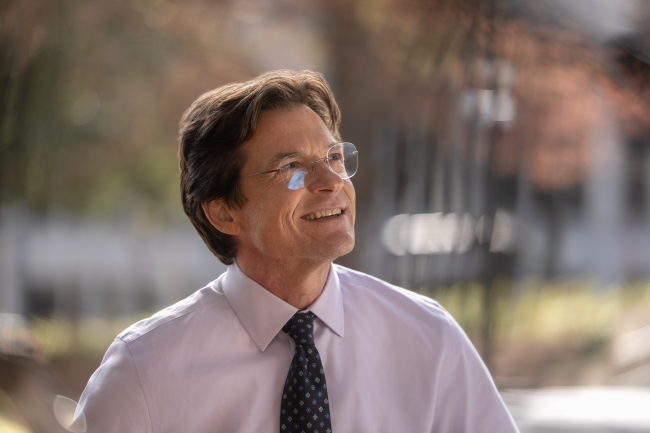
Jason Bateman often plays the smartest person in the room. Whether he’s deadpanning his way through Arrested Development or directing and starring in the gritty, Emmy-winning crime saga Ozark, his signature screen persona is fiercely sharp and endlessly savvy.
But for the HBO Max original limited series DTF St. Louis, Bateman takes on a much more vulnerable role as Clark Forrest, a simple suburbanite caught up in a tangled affair and a sudden murder investigation.
The Steven Conrad-helmed project required Bateman to strip away his typical onscreen confidence, quite literally, between diving into awkward intimate scenes with Linda Cardellini and dancing in his underwear with David Harbour.

“I’m not someone who has done a whole bunch of intimate scenes, whether dancing in my underwear or bedroom scenes. But the character I was playing was so disarmingly naive, vulnerable, and sort of virginal that it allowed me to jump into those without any real sense of shyness — because the character was the one who was shy in those scenes,” he explains. “I didn’t have to worry about Jason being shy; I could hide behind the insecurities of the character.”
Gold Derby sat down with Bateman to break down the hit series, dissect that infamous underwear scene, and discuss what it felt like to step outside his comfort zone.

Gold Derby: Much of the tension in DTF St. Louis relies on whether the audience can trust your character, Clark, and Carol, played by Linda Cardellini, after Floyd (David Harbour) is killed. How did you balance that mystery to keep everyone guessing?
Jason Bateman: Linda and I were always trying to play each scene in a way where you get that sense that this character is unpredictable and not necessarily someone you can rely on. When in fact, by the end of it, you realize there’s really nothing to worry about with either one of them. Sort of shame on us as an audience for thinking that level of kindness, honesty, and openness was the sign of a killer, rather than just someone who hadn’t worked out how to be full of it.
Did you have a favorite day on set or a favorite scene to shoot?
I would say the big final scene that David and I have — the dancing in the underwear scene. So much comes together in that scene for the characters, the story, and the plotline. That was a great day. I had that day circled on the calendar for a long time, and there was a lot of anxiety leading up to it because I knew we had to get it right and I wanted to do my part. As soon as we finished the first take, there was some relief, high fives, hugs, smiles, and tears on set. It felt really good that we’d all accomplished something as a unit, because it was a tricky scene to figure out how to shoot and light, too.

Was the chemistry between you, David, and Linda instant?
Chemistry is not difficult to have with someone if they’re kind. Linda and David are two of the greatest people I’ve worked with, and they’re very easy to get along with. There was a great friendship between the three of us on the set in between setups, so it’s easy to have that.
Your character, Clark, is a departure from the roles you’ve played in the past. What was it like shedding that signature savvy persona to play someone so disarmingly simple?
I’ve never really played a guy as kind and as simple as this. I’m usually playing the protagonist — the person who needs to be very current, relatable, a man of many talents, and super savvy. This guy is much less savvy and much less sophisticated than your average viewer. He’s just a very simple person, and I really enjoyed playing that instead of being the sarcastic, alpha, prickly kind of guy.
As an Emmy-winning director, are you ever fully able to shut off that side of your brain when you are strictly acting in a project?
Not really, but it all depends on how you define “director brain.” For me, the director brain is able to appreciate and observe all the work going on around you before the acting starts, after it finishes, and while it’s happening — the camera moves, the boom operator, the cameraman. Everyone’s working, and you just happen to be the person the camera is pointed at. It’s helpful to be aware of how all that stuff works so that you can help facilitate it. If the dolly is late getting to its mark, you can delay your next line so the camera gets there and you don’t have to do the take over again. I want to keep that brain on when I’m acting to help make the scene work as best I can and do what the director is looking for. I like knowing what the director’s job is so that, as an actor, I can help them get done what they’re trying to achieve. I like to be a good soldier when I’m not directing.
Between starring in DTF St. Louis, filming Black Rabbit, and co-hosting your SmartLess podcast, your schedule is incredibly packed. How do you unwind?
I’ve got two daughters I’m crazy about and a wife I love to death, so just hanging out with the family is great. As it is for anyone, that time is so comfortable and informal, and you can just allow yourself to sometimes do nothing, say nothing, and just be in the same space with one another. I like to be home and hang out with them.
You grew up in the industry, and your father was a director and producer. Was a multihyphenate career always something you felt destined to pursue?
Instead of going to the park to throw the ball, my father would take me to the movies. That was our bonding. He would explain to me on the drive home what we saw, and he would try to explain not only the plotline, but also what the acting was, what was good and bad and why, and what the director did. It was always on my radar. Even as a young actor working on sets, I’d start to identify some of the things he may have been talking about. Eventually, getting the chance to have that job and that kind of responsibility was something I was very eager to take on — if for no other reason than any little kid wants to make their parent proud.
