
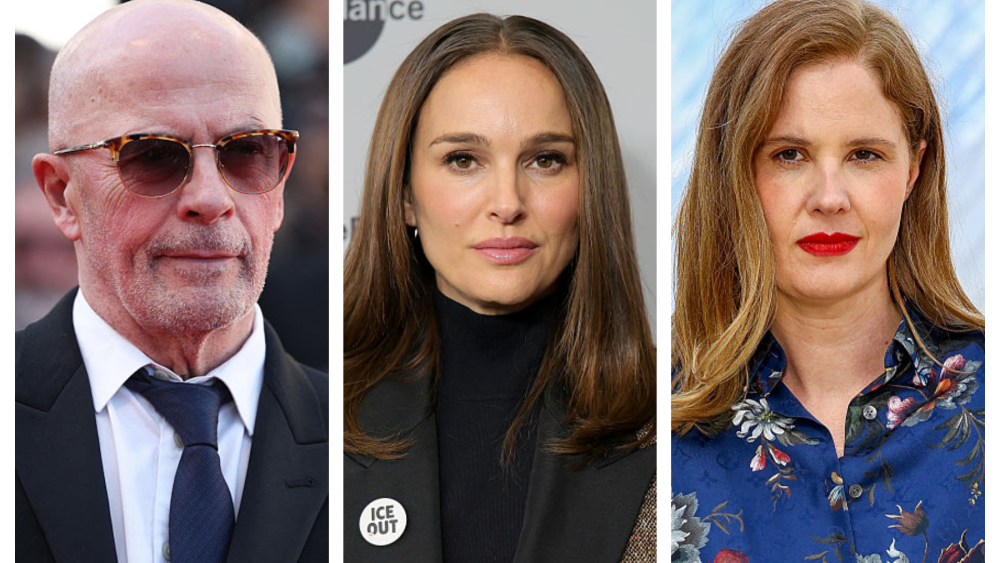
Natalie Portman, Justine Triet (“Anatomy of a Fall”) and Jacques Audiard (“Emilia Pérez”) are among the 350 industry figures who have signed an open letter condemning the cultural boycott of Israeli director Nadav Lapid. The latter is a fierce critic of Benjamin Netanyahu’s government who has lived in self-imposed exile in France since 2021. His latest film, “Yes” was called a “blistering attack on Israeli nationalism” by Variety.
The controversy stems from Lapid’s planned participation as a jury member at the FID Marseille international film festival, running July 7–12. Festival director Tsveta Dobreva said Lapid was initially invited “solely out of respect for his cinema,” but she soon began receiving calls demanding the withdrawal of his invitation. When pressure intensified, the festival proposed a scaled-back arrangement — Lapid would simply present his 2011 debut feature “Policeman” at a public screening and book signing. But around 10 filmmakers ultimately withdrew their films from the selection, forcing Lapid to pull out entirely.
Le Monde published two different tribunes, on Monday and Tuesday, defending Lapid. The one signed by Portman, Audiard and Triet, alongside Rebecca Zlotowski (“A Secret Life”) and Michel Hazanavicius (“The Artist”), among others, calls the boycott “an intellectual failure” and argues that “Russian, Israeli, and Iranian filmmakers should not be threatened with being erased as a form of atonement for crimes committed by governments of which they are often the most ardent critics.” It highlights Lapid’s track record as “the greatest Israeli dissident artist, working tirelessly to denounce the fascist and colonialist excesses of his government, its criminal moral failures, in films that have won awards all over the world” — and argues that his withdrawal from a French festival “ought to alert us and mobilize us beyond this aberration.”
The letter asks rhetorically: “At what level of public funding does one decide that a work, or its author, however critical he may be, becomes the mouthpiece of a criminal government? Nothing justifies the cancellation of an artist’s voice.” The signatories also argue that continued engagement, rather than exclusion, is the more effective form of political pressure. “It is by continuing to invite them relentlessly that this lever of contestation is maintained,” they write, pointing to Russian director Andrei Zvyagintsev, who used his acceptance of the Grand Prize at Cannes last month for “Minotaur” to call on Vladimir Putin to “end the carnage” in Ukraine. “Those who call for artists to be completely erased from the public sphere must be opposed,” the letter concludes. “Cinema must be that refuge.”
A second tribune, titled “Cinema Is Not an Embassy” and published on Monday in Le Monde, was signed by Alice Diop (“Saint Omer”), Arthur Harari (“The Unknown”), as well as producers Saïd Ben Saïd and Judith Lou Lévy, who worked with Lapid on “Synonyms” and “Yes” respectively. It denounces a “campaign of intimidation” targeting the filmmaker, and “a deliberate effort to exclude a filmmaker from a space of discussion and creation,” and challenges the logic behind the boycott. “In what way does the presence of a filmmaker on a jury or the screening of one of his films make him a representative of a state? Inviting an artist to a festival is not about elevating him to the status of a cultural ambassador, but about recognizing a body of work, a career, and a cinematic vision.” The op-ed asks pointedly, “How could Nadav Lapid — whose work has been built over many years on a direct critique of the policies pursued by his country’s various governments, at the cost of taking real risks, and who has publicly denounced, on numerous occasions, the destruction of Gaza — be equated with any form of Israeli cultural embassy?” It calls this conflation “a logic of assignment” that reduces an artist to their nationality.
Franco-Algerian director Narimane Mari, one of the filmmakers who withdrew her film, rejected the accusation of censorship: “We are not condemning a human being — we are refusing a cultural and political model that continues to be maintained,” she was quoted saying in Le Monde.
Those who objected to Lapid’s participation at the festival pointed out that he accepted partial funding for his 2025 film “Yes” from the Israel Film Fund, which they view as an arm of the Israeli state. In reality, the Fund stands as the country’s primary source of financing for Israeli and Palestinian films, and operates independently from the government. It has a long legacy of supporting liberal voices, such as Ari Folman’s “Waltz With Bashir,” Samuel Maoz’s “Lebanon” and most recently “Yes.” Similarly, the Israeli Film Academy Awards clashed with the government last September after the anti-war Movie “The Sea” won the top prize at the local awards ceremony and was submitted as Israel’s candidate for the Oscars.
In an interview published on June 6 in Le Monde, Lapid said he agreed to withdraw to avoid putting the festival in difficulty, but expressed frustration at the escalating pressure. “For a year, it was my film ‘Yes’ that was being attacked. And then, suddenly, my mere presence became unacceptable. I asked myself: what exactly do they want? That I stop making films? That I leave France? How far will this go?”
He also warned of a broader chilling effect on cultural institutions: “Many festivals are now beginning to avoid certain films or people simply out of fear of controversy. And paradoxically, those who claim to want to draw attention to Palestine sometimes produce the opposite effect — films disappear, debates no longer take place, and everyone retreats into silence.”
Lapid, who previously won the Golden Bear in Berlin with “Synonyms” and the Jury Prize at Cannes with “Ahed’s Knee,” nonetheless said he refuses to regard the boycotting filmmakers as enemies, suggesting their actions reflect “powerlessness, anger and immense frustration at the political inaction around Gaza,” and reiterating his own long-standing support for real political sanctions against Israel. “The real issue is genuine political sanctions against the Israeli state — which I have supported for years,” he said.
