
Great Scott! Or, to be more accurate, Great Lester! In its fifth season, Only Murders in the Building found an inventive way of putting a fresh coat of creative paint on its well-explored location, the Arconia, the Upper West Side apartment building where residents and employees die on a disturbingly regular basis. But hey, at least that keeps our true crime podcasting heroes Charles, Oliver, and Mabel — played by Steve Martin, Martin Short, and Selena Gomez — in business.
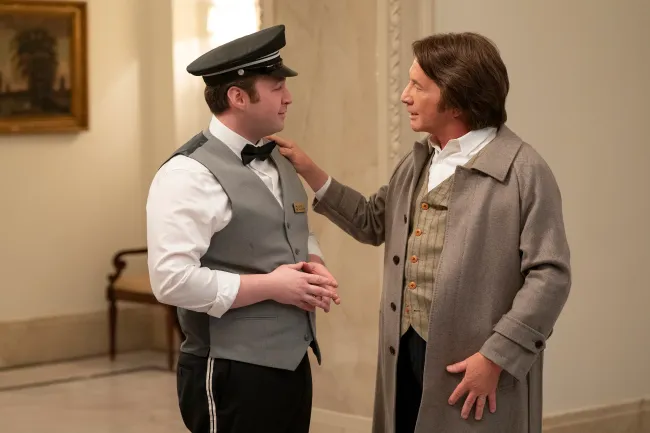
The case the trio is out to crack in Season 5 is the murder of the Arconia’s beloved doorman, Lester, who has been played by Teddy Coluca since the show’s 2021 premiere. And the second episode passes the proverbial mic to Coluca for a Lester-centric episode that flashes back in time to his first day on the job and then moves forward through the decades to illustrate how his personal history is intertwined with the building. Marty Supreme scene stealer Emory Cohen plays the young Lester, who interacts with more youthful versions of our central sleuths.

The task of turning back the clock — and then letting it tick forward again — fell to the experts crafts team behind Only Murders in the Building. In this exclusive making of panel interview, Gold Derby spoke with select members of that group to share how “After You” came together. Watch the video above and read on for select comments below.

John Hoffman (showrunner/co-creator): Once we knew that Lester was going to be the victim of the season, it really brought out the question of, “How do you let that ripple through the themes of the season, the movements of the plot, and the movements of character revelations?” Knowing that he was a doorman in a New York City pre-war apartment building for over 30 years, that job is very specific to a big city and then the power dynamics of a big city. All of that felt like a part of something that we could look at and recognize how many people we pass by in our day who are just regular people that you only know in intermittent spurts. This episode felt like a way to get deeper with the person who’s actually watching everyone pass by and connecting to people in ways that are both intangible and certain.
Shelly Westerman (editor): The editing of the episode was very beautiful and very fluid. And I would play some of the score to help me get a rhythm and the way it just automatically matched picture was wonderful. The hardest thing for me with that episode was getting it down to time; it was a little bit longer and just trimming anything was so hard on my heart.
Dana Covarrubias (costume designer): We wanted to keep the passing of time really subtle, becuase if you take someone who is in their 70s and put them in vintage clothing, it can look a little strange or costume-y. So especially with Steve and Marty, we wanted keep the fashions very simple. But it was also fun because we got to look at a lot of they were actually wearing in those days, and we definitely stole some inspiration from some of the actual looks they wore. One my favorites was Charles in that very simple T-shirt with an oversized ’90s blazer and then the backward flat cap. Steve really wore that on a red carpet in the ’90s, and it looked so good on him.
Patrick Howe (production designer): So much of that episode took place in the Arconia lobby, which had a fixed decor from the late 1800s when it was designed. So we really just swapped out styles of furniture for certain decades, because that didn’t change as frequently as peoples’ clothes did. And then other changes were more seasonal, like if we had Halloween or Christmas decorations.
Hoffman: We’re a half-hour Hulu comedy, but I wanted a certain elegance to the episode, so I referenced one of my all-time favorite films: Distant Voices, Still Lives by Terence Davies. The way that movie post-cards through the history of a family with that fluid camerawork was the model that I shared with the whole team. If you’re a fan of the show, that episode is built on the history of what’s been established over four seasons, so it was helpful to be able to give a language for how we were going to tell it.
When I met Emory, he started telling me this story about how he lives a few blocks up from where we shoot, and he is a truly authentic New York character himself, not to mention a complete sweetheart of a guy and a hugely talented actor. He did a great amounts of research, and would interview other doormen in New York. He had a whole history for Lester, but also met with Teddy to find ways their performances could parallel each other.

Covarrubias: When Emory first starts the job, he’s aspiring to be an actor and thinks this is just temporary, and then you start to see that transition of him taking the job on. We were debating whether he should rebel against what the uniform is, but then we thought it would be nice to show him embrace an even more traditional sense of uniform so we started that with the white gloves and the bow tie, and that transitions as he gets older and becomes head doorman. That’s the moment where he can say, “Now I can put my own spin on how I want to represent the building.” So he transitioned to a straight tie instead of a bow tie, but kept the gloves.
Howe: I really enjoyed the big story point of Lester hand-operating the elevator. I learned a lot about how those function and the kinds of noises they made. We were fighting logistical things, because in real life, there aren’t any doors in the space, but we wanted doors for our lobby. And the story of “After You” wasn’t going to work well without some doors! We hashed everything out to get the best and most authentic sounds for what we were doing. And, you know, I weep all the time about this episode. I don’t know anyone who doesn’t comment to me about this particular one and how extra-charming it is. And I’ve always said “After you,” whenever I’ve held doors open for people!
This interview has been edited and condensed. This article and video are presented by Hulu.
