
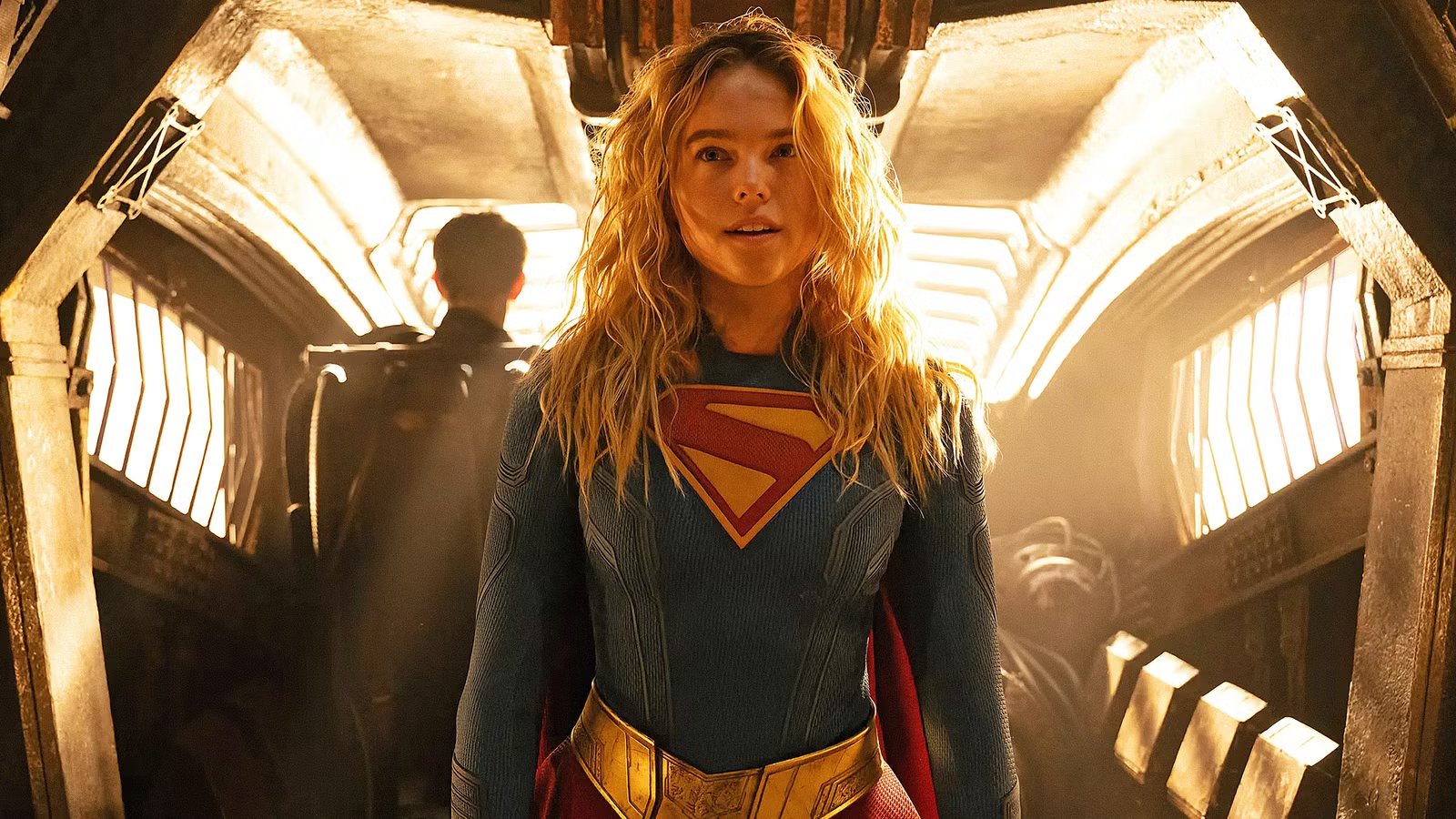
We joined Supergirl just 10 days out from the end of shooting, but that did not mean things were winding down. Executive Vice President of Production Chantal Nong Vo revealed that the team would remain at Warner Bros. Leavesden in Hertfordshire, England, for a maximum of three more days before heading up to Scotland and then further north to Iceland to finish on location.
Collider visited set in April 2025, which marked the production’s 70th day. Director Craig Gillespie compared it to the last week of school, with everyone aware the end was in sight, yet remained determined to make the most of the time left. The entire unit was on the backlot filming a flashback sequence set on Krypton, an emotional scene depicting Kara’s mother’s funeral. Everyone was dressed in cream and blended into an imposing Romanesque colonnade flanked by a lake. During its time at Leavesden, production had occupied the backlot, five sound stages and built so many smaller sets that the team had lost count of the final number.
The scale of Supergirl was immediately clear, but what stood out most were the finer details and the level of coordination required between departments. From hearing how DC Studios co-chiefs James Gunn and Peter Safran worked with Gillespie to learning first-hand from the craftspeople on set, Supergirl was a highly collaborative production. Creative decisions were being made collectively, with each department building on the work of the others to bring a shared story to life. The result is a wealth of thoughtful visual choices and character-driven details that audiences may not consciously notice, but will undoubtedly feel.
‘Supergirl’ Is Deliberately Not Trying to Be ‘Superman’
Superman had yet to be released at the time of our visit, so anticipation was still building around the film that would define the style, tone, and direction of the new DCU. While Gunn and Safran oversee the broader shape of the universe, Craig Gillespie (I, Tonya) brought his own blend of quirky humor and emotion to Supergirl, with Ana Nogueira making her feature screenwriting debut.
When Superman did eventually launch, Clark Kent’s story was full of optimism and heroism, but Supergirl is deliberately changing suits. The film reflects Kara’s trauma and cynicism shaped by her memories of Krypton’s destruction and the loss of her family, and Gillespie set out to make an unconventional coming-of-age story. Kara has already fought crime on Earth, so her journey is not about becoming a superhero, but about doing the role with her full self. As Nong Vo puts it: what do you do with a loss so profound that it defines your life? And what do you do after it?
While the feature shares some DNA with Guardians of the Galaxy, Dune, and Star Wars, Unit Publicist Sophie Scott was keen to emphasize that its primary inspiration remains Tom King’s eight-issue miniseries Supergirl: Woman of Tomorrow. Supergirl is a space western wrapped in a superhero adventure, following Kara Zor-El’s interplanetary journey alongside Krypto and, later, Ruthye Marye Knoll (Eve Ridley), a young girl seeking justice for her father’s murder at the hands of Krem of the Yellow Hills (Matthias Schoenaerts). While the comic is told from Ruthye’s perspective, the film keeps the relationship between the two girls central while remaining fundamentally Kara’s story.
Another key relationship stems directly from King’s original unrealized pitch for Woman of Tomorrow: a team-up between Supergirl and Lobo, with the pair occupying roles similar to Mattie Ross and Rooster Cogburn in True Grit. According to Nong Vo, Jason Momoa had long expressed interest in playing the character, and the team found a way to incorporate him that both served the story and fulfilled his ambition. She described Lobo as having a very high-impact 15% presence in the film as a bounty hunter whose goals align with Kara and Ruthye’s, but only when it benefits him.
“And then obviously to be lucky enough to have cast somebody like Milly, who this is her first movie. I didn’t wanna say that in front of her, but like she obviously knows it. You would think it was her 10th.” – Chantal Nong Vo
Momoa’s casting gives the film a big selling point, but throughout the visit it was Milly Alcock who received the most praise, which she met with a bashful look. Although this is her first feature, nobody on the production spoke about her like a newcomer. Present for approximately 95% of the shoot, Alcock tackles extensive stunt work, emotionally demanding material, and dialogue in multiple languages. Nong Vo shared that she brings a free-spirited, punk-rock energy to Kara, creating a heroine who feels delightfully messy in all the ways your twenties are supposed to be.
‘Supergirl’ Has Been Building a Galaxy the Old-Fashioned Way

One of the most striking aspects of the Supergirl set was how much of the film physically existed. While visual effects will undoubtedly expand the scale of the finished movie, the production’s approach was firmly rooted in practical filmmaking, which is going to cause a significant buzz with fans. Neil Lamont led production design and visual development, drawing inspiration from architecture around the world, while Lee Sandales, fresh from winning an Academy Award for Wicked, oversaw set decoration. Together, they created a vast network of fully realized environments that allowed performers to naturally inhabit the worlds, lending an authenticity to Kara’s space exploration that would have been difficult to achieve against empty blue screens.
Supergirl is first and foremost a planet-hopping adventure and the production design needed to give each destination its own visual identity. Perhaps the most mythic for superhero fans is Krypton, which is explored here through flashbacks. Adorning the walls of the Leavesden production offices were complex drawings, renderings and diagrams, depicting life inside Argo, the domed capital city built in a desperate attempt to preserve civilization. According to Scott, the production’s interpretation of Krypton draws heavily from classical architecture, inspired by the Roman Empire and ancient Greece. Towering columns, expansive walkways, vast lakes, blossoming trees, and pristine public spaces create a sophisticated world — albeit one living on borrowed time. The costumes of Zor-El (David Krumholtz) and Alura In-Ze (Emily Beecham) were inspired by the cream-colored architecture and designed to feel like a uniform consistent across Kryptonian society.
The Krypton set was also key to storytelling. Earlier in production, the environment had been filmed in its prosperity but by the time we arrived, it had been deliberately distressed. The lakes had been contaminated with what Scott jokingly described as green Kryptonite stuff, and the crew had physically painted decay to show the empire’s collapse. Production had also built more personal sets on Krypton including Kara’s family apartment, complete with enormous glass windows inspired by a power station on the English south coast where Scott grew up. As well as Zor-El’s laboratory and the escape pod Kara uses to leave, mirroring Kal-El’s own journey to Earth.
By the time we connect with her in the present, Kara has embraced spacefaring van-life aboard an RV inspired by Riggs’ caravan in Lethal Weapon. The ship’s interior resembles a teenager’s bedroom more than a Fortress of Solitude with books, Polaroids, and vinyl scattered across the floor — it looks as free-spirited and chaotic as she is. When her RV is stolen, she is forced to find a new way to travel. The most memorable mode of transport of the visit was the Wormhole Bus. It is wider than an airplane cabin and was packed with stunt performers wearing elaborate prosthetics to denote the range of alien lifeforms traveling on intergalactic public transport. Rather than relying entirely on visual effects, the team also built the bus to physically rattle during filming. The journey eventually leads Kara to a space rest stop which was one of the most colorful environments created for the production. Neon lights illuminate rows of alien snacks and slushies. Props designed an animatronic slug-like creature to occupy this intergalactic 7-Eleven — a creature that poops popcorn — leaving a lasting impression on everyone who toured the set.
“Think of the worst possible Greyhound you’ve ever been in, but into galactic terms.” – Sophie Scott
The most impressive set on Supergirl, however, was Evely Town Square. Named after Woman of Tomorrow artist Bilquis Evely, it echoes Krypton in decline with dusty floors, piles of rubble and rusting structures. The M-stage was vast and immersive with fully dressed streets and functioning businesses, including a store that crew members had to push a trolley through to test its real-world accuracy. Evely’s neon-lit pub became another favorite among the crew, serving as a location where Kara and Ruthye eat fried eyeballs together. They look disturbingly convincing up close but are really made from fondant icing with a cake center — Eve Ridley reportedly ate around 40 of them during filming.
“You’ve got to have a sweet tooth. That’s a nice thing about being a 12-year-old.” – Sophie Scott
Kara Zor-El Has To Earn Wearing the Iconic Suit in ‘Supergirl’

Like every department we spoke to on Supergirl, the costume team described a process built around detailed collaboration. Costume designer Michael Mooney (Aquaman and the Lost Kingdom) explained that decisions were shaped through constant conversations with the props department, armorers, set designers and special effects teams.
We already saw Supergirl make her drunken debut at the end of Superman complete with the first look at her iconic suit. The two productions developed a shared visual language and the suit went through numerous iterations before cameras rolled. Mooney revealed there was never any serious discussion about moving away from the classic boots-and-skirt combination, and the team committed to retaining the character’s comic book appearance.
The challenge instead was to modernize the suit for movement and action, so that Kara doesn’t look powerful because of the suit—the suit looks powerful because of Kara. Milly Alcock’s physical preparation played a major role in that process. Because of her training, there was little need for heavy muscle padding, resulting in one of the most body-close superhero costumes the department has produced. Stretch fabrics and new texture-printing techniques were introduced to create an armored feel while remaining highly flexible. The famous chest glyph required several adjustments after early versions restricted movement in the surrounding fabric, while the skirt, belt and cape were all designed to maximize motion during fight scenes. Mooney revealed that the cape fabric alone took around three months to source worldwide! The feminine silhouette of the skirt and boots alongside the flowing movement of the material allowed for a stark and powerful contrast when Supergirl went up against much larger frames like Lobo and Krem. The only problem was the over-the-knee boots repeatedly required quick-turnaround repairs after intense stunt work.
Although the Supergirl costume is central to Kara’s arc in the film, she spends much of the story away from Earth and her responsibilities as a hero. Nong Vo explained that this represented one of the biggest departures from the source material, so her civilian wardrobe became just as carefully considered as the suit itself. Central to the look is a long coat that functions almost like a cape and a Blondie graphic tee. Hundreds of indie bands were considered intentionally avoiding mainstream acts before Craig Gillespie settled on Debbie Harry. Around 30 versions of the shirt were produced with print sizes and colors carefully adjusted to ensure the design remained visually congruent on camera.
Lobo’s look emerged from a particularly collaborative process with Jason Momoa himself. Mooney initially drew inspiration from biker culture and early twentieth-century Army dispatch rider coats before opting for something larger. Lobo’s enormous coat is the heaviest costume in the production and was designed to dramatically move as he rides into a scene on his spacehog. Underneath is an embroidered jacket that took approximately three weeks to complete, with one costumer dedicated entirely to finishing it. The team also hand-sculpted Lobo’s buttons in brass, silver and rubber and developed a large chain necklace complete with a grenade. Momoa was heavily involved throughout and pushed for a genuine metal chain despite lighter alternatives being easier to work with. He also suggested claw-like fingernails, which replaced an earlier fingerless glove concept. According to Mooney, few actors could convincingly wear a costume of Lobo’s size and weight, but Momoa’s commanding physical presence allowed the department to push the design further than they otherwise might have.

‘Supergirl’ Takes Flight in New Look at the Most Anticipated Superhero Movie of the Year
DC’s next major big-screen hero is ready for a fight.
If It’s on Camera, the ‘Supergirl’ Props Team Are Going To Make It Exist
Old-fashioned, practical film-making continued into Supergirl’s props department which, at its peak, comprised around 300 people with 75 prop makers and 10 painters. Supervising Hand Props, Charlie Horwood, acknowledged that if something appeared on camera, the team wanted it to exist for real. The clearest example of this approach is Krypto. While many assume the superdog exists only as a digital construct, Horwood presented a practical version, made from an IKEA rug which can breathe, blink, and wag its tail.
The most difficult prop to make for Supergirl was Kara’s Space iPod. She carries both an original Nano and a futuristic alternative during the film and for the latter there was no obvious starting point. The props team debated how closely it should resemble Apple’s primary design while still feeling like technology from another world. Finding working original iPods also proved difficult — the Nano functions as new, while the space version doesn’t, so its screen content can be added by the VFX team.
“A sword’s a sword. A dog’s a dog. But what’s a space iPod? Who knows?” – Charlie Horwood
The weapons used in Supergirl began with recognizable real-world silhouettes before pushing into sci-fi territory. The team’s goal was often to space-ify familiar objects, making them feel bigger, brighter and stranger. Most major weapons were created in multiple versions, including highly detailed hero props for close-up shots. Airsoft replicas provided a strong starting point, as they already featured moving parts and functional mechanisms, while rubber versions were produced for stunt sequences. One of the most pivotal weapons in the film belongs to Ruthye’s murdered father and early discussions explored the possibility of using his sword more like a walking stick. As the story evolved, however, it would be actively used, including during the scenes filmed in Scotland shortly after our visit. As Ruthye is a young character expected to carry the sword for long periods, the props team produced lightweight versions that would remain comfortable on long days. The design itself draws heavily from the comics while incorporating Afghan influences of intricate gold filigree.
Matthias Schoenaerts and Jason Momoa both collaborated with the Supergirl props team to enhance their characters. Schoenaerts suggested that Krem should always carry provisions for a long journey, so the team created a double-headed rat and bird-like creatures which could be hung off his belt and eaten in scenes. Momoa’s last minute request was for Lobo’s cigar made out of a vape to illuminate his face. Built in around six hours, the final result is Horwood’s favorite and is paired with a brass punch lighter which Lobo slams against a table to activate.
Before we left Leavesden, the team screened exclusive footage from the film. There were certainly powerful moments involving Kara, yet the strongest reaction came when David Corenswet‘s Superman appeared with his broad Christopher Reeve-esque smile — there was clear excitement bubbling for the start of the DCU. Now, as Supergirl finally heads towards its release, audiences should prepare not only for the same action-packed spectacle but also take time to appreciate the film’s attention to detail. Fans will ultimately decide how successful the production’s shared vision is when it arrives in theaters later this month. But after spending a day inside its worlds, it’s clear that Supergirl has been built with an unusual level of coordination and care worth watching out for.
Supergirl is released in theaters June 26.

- Release Date
-
June 26, 2026
- Runtime
-
110 Minutes
