
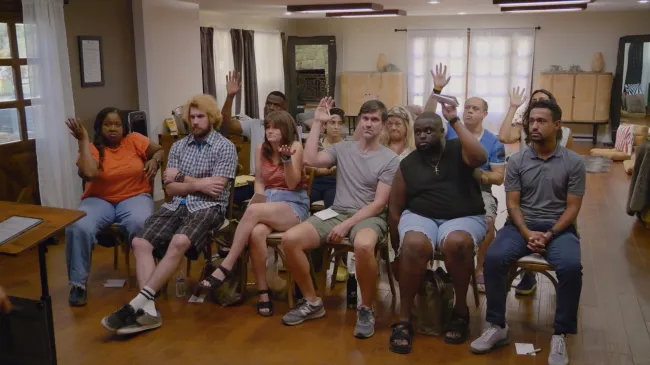
While most production designers spend pre-production thinking about the aesthetics and style of everything in front of the camera, Joe Warson had a different challenge. The production designer for Jury Duty Presents Company Retreat needed to hide nearly 50 cameras across Oak Canyon Ranch and make sure the show’s unsuspecting hero never saw any of them.
But after decades of working together on hidden camera shows like Scare Tactics, Warson and his crew know how to keep their stars in the dark.
Warson spoke with Gold Derby as a part of our Emmys production design panel and shared some of his secrets about concealing cameras and why the Jury Duty franchise has been a nice change of pace for him and his team.

Gold Derby: This is a really unique show just in general, but I have to imagine the job of production designer changes greatly considering the format. How does the nature of the show affect your approach to this job?
Joe Warson: Well, it’s so run-and-gun. What we’re trying to imagine is “Where in the heck am I going to put these cameras?” That is the burden that was the hardest thing. We had about 46 hidden cameras on this show, and for each one of those cameras, I am always suffering over. If our hero gets a whiff of what we’re doing, it’s over. It’s really stressful.
What are your primary challenges when hiding cameras?
I’m looking at “What are my repeats? What can I repeat? Are there any mirrors I can repeat? Where can I cut holes in walls? What can I do in this room? Where can we do something that’s just gonna blend?” So it is really hard because not only does everything have to be real and function, but I can’t have set walls. It has to blend and be invisible.
Where do you hide cameras in a yurt?
That’s a great question. You have to envision these are all going to be soft walls and obviously drapes. There’s a little area where we just had a raised stage and behind them is like that Oak Canyon logo. I had that over a slatted wall, so behind that is a black — a dark tinted glass. And behind that are cameras and camera rigs. That’s where we got the majority of our footage. That was the biggest hide in there.
What about shots on the grounds that were more out in the open?
We had these mobile utility carts — like gardner carts. We literally had a teamster drive around a cart, position it, and we’d open up this roll-up door with our camera guy behind another piece of glass. We’d busy up the glass, so it didn’t look obvious. And then the teamster would just literally be raking leaves to look like he was doing something.
Where did you get all this knowledge about how to hide cameras? It doesn’t seem like it’s within the normal job description of a television production designer.
Many years back, I was given an opportunity that actually changed my life. I did a show called Scare Tactics, which was one of those shows where we hid cameras. We did pranks with Bigfoot one day, a UFO the next, so I just cut my teeth doing that years and years ago. Then I got on this wave like, “That’s the hidden camera guy. That’s the prank guy.” So I’ve done a slew of hidden camera stuff. If there’s something that I’m good at, it would be in this realm, just knowing the angles of glass to tilt and what it can reflect back down onto. I’ve been with my same crew for 20-something years, 30 years maybe, so I have a lot of knowledge, unfortunately, of being able to hide cameras and prank people. But this is the first show where we weren’t taking advantage of people, but actually doing some good.
For someone to even consider that there might be a hidden camera, it’s a pretty big logical leap. How do you know when it’s good enough?
We do a walkthrough with someone who doesn’t know what’s going on, like a test. That’s always a great relief to me, to see how people react to that. Back in the days of Scare Tactics, there was no way we could do a look like shooting through glass while getting any sort of focus or without blasting light. All of these new cameras have low-light capabilities. I think that’s actually one of the criticisms that I’ve heard on this second season of our show. People are saying, “It looks too good.” It looks good because that’s our cameras, and because we are truly shooting almost all hidden camera. We had a bajillion cameras everywhere. That’s why it took like two years for post-production. Can you imagine going through all that footage? That’s ridiculous.
This interview was edited for length and clarity.
This article and video are presented by Prime Video.
