
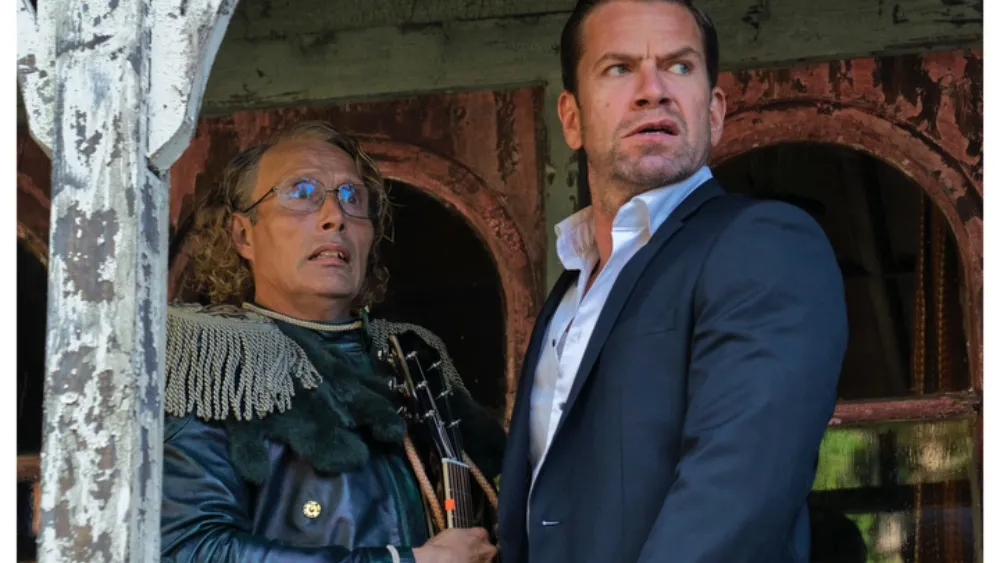
Though he’s a prolific screenwriter with a number of popular arthouse titles to his name (“After the Wedding,” “In a Better World,” “The Promised Land”), the directorial efforts of one Anders Thomas Jensen (including “Riders of Justice” and “Men and Chicken”) are rarer birds in all senses of the term — usually fusing antic comedy with darker genre storytelling and, most consistently of all, the star presence of Jensen’s longtime pal Mads Mikkelsen. All those elements are present and correct in the pair’s latest collaboration “The Last Viking,” so its extreme tonal swings between absurdist farce and hardboiled crime thriller shouldn’t come as any surprise. But they’re disorienting nonetheless: A madcap ride that is diverting but never quite enjoyable, the film finds the silliest and grisliest extremes of the Jensen formula this time fighting each other more than they balance each other out.
Opening Stateside today following an out-of-competition premiere at last year’s Venice Film Festival, “The Last Viking” was a substantial hit on home turf — outgrossing Jensen’s previous features as helmer — but perhaps Danish Oscar selectors doubted its crossover potential: Though shortlisted to be the country’s Best International Feature submission, it was passed over for “Mr. Nobody Against Putin.” It’s certainly an eccentric stew even by the filmmaker’s standards, wrongfooting viewers from the outset with a picture book-style animated opening sequence (bookended at the close) that plunges into apparent Viking lore, telling the story of an ancient king who, after his son lost an arm, ordered the rest of his subjects to sacrifice an arm in solidarity.
The metaphorical relevance of this introduction does eventually become clear, though audiences aren’t likely to keep it in mind, given how much other business Jensen’s script soon gives them to contend with. A second, more on-topic prologue introduces slick thief Anker (Nikolaj Lie Kaas, another fixture of Jensen’s films) in the midst of a heist that is going wrong; with the police on his tail, he asks his naive brother Manfred (Mikkelsen) to bury the loot. 15 years later, Anker is freed from prison and returns home to find Manfred a new man: John Lennon, to be precise. Manfred, you see, has been diagnosed with dissociative identity disorder, and has convinced himself that he is the late — but now living — Beatle. Address him otherwise, and he’ll act out in ever more alarming ways, even hurling himself out of a moving car at one point.
There are, as you might imagine, any number of difficulties to having your brother claim to be John Lennon — though the most pressing one for the free-but-not-reformed Anker is that Manfred professes no memory of where he hid the money. With gang bosses breathing down Anker’s neck, that necessitates a visit to his best guess regarding its location: the brothers’ childhood home in the woods, now a touristy Airbnb run by a bickering couple (Sofie Gråbøl and Søren Malling) with no sense of what they’ve signed up for. Also along for the ride, for reasons that make marginally more sense on screen than they do on paper, is Manfred’s new shrink Lothar (Lars Brygmann), as well as two similarly delusional psychiatric patients — recruited to join Manfred in forming a Beatles tribute band (or, in their minds, the original Beatles) for therapeutic reasons.
Plus there are further characters, subplots and flashbacks rambling around in this slightly overstuffed affair: The brothers’ long-suffering sister Freja (Bodil Jorgensen), in particular, gets short shrift. But Mikkelsen’s drastically against-type performance as the damaged, seemingly gentle but volatile Manfred consumes much of the oxygen here. Under an unflatteringly greasy mop of curls, he clearly relishes getting to play the oddball for a change, while Kaas is left to hold down proceedings with tough-guy stoicism. Mikkelsen gives a star turn in a character-actor part, so committed to its own arrhythmic delivery and herky-jerky physicality that you can’t take your eyes off him.
The sheer bravura strangeness of his work makes “The Last Viking” worth a look even as the film goes from offbeat to plain off-the-rails. The extreme violence of the thriller component — visited with disproportionate force upon women — simply never sits comfortably with the sunny zaniness coloring a study of mental health and healing via Fab Four cosplay, to the point that when the film most actively reaches for the heart, we wonder if we’re about to be pranked. The singularity of “The Last Viking” is to be celebrated, on several fronts; the world would be a more unnerving place with more films like it.
